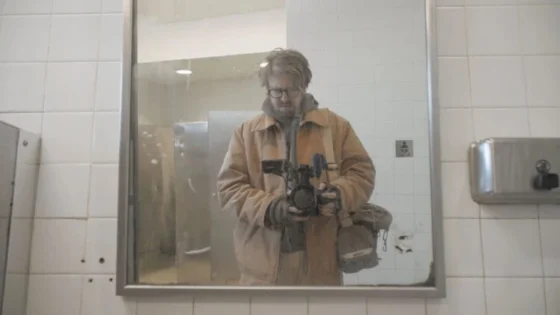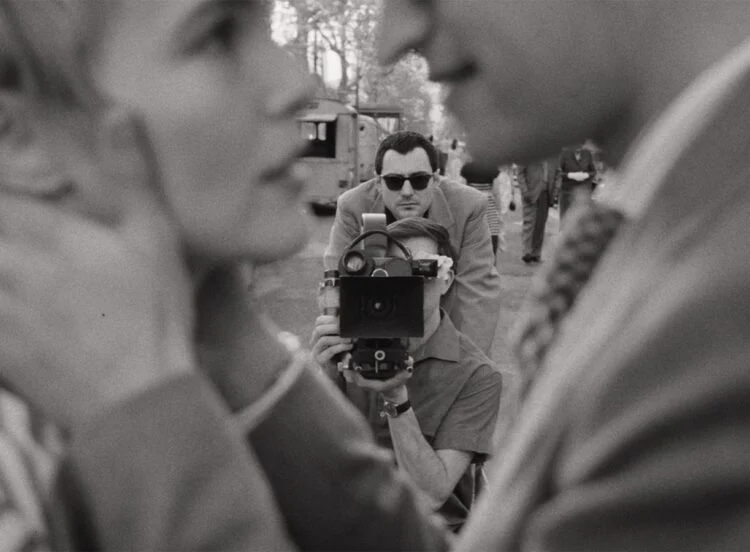
You would think that any filmmaker—no matter the Oscar nominations, an enviable ability to work with A-list stars and complete unknowns at once, several iconic films to your name, a name that is itself some kind of catch-all descriptor—would be rather preoccupied with Criterion’s 4K release of their new film; probably more so a quote-unquote “love letter to cinema.” Richard Linklater, here as elsewhere, is not like most filmmakers. By his account, the process whereby Nouvelle Vague was brought to that best-case forever home depended most on doing little: “Every time we came to a part where we could make it look better, or clean—do something—I was like, ‘No, we want it to look exactly like how it looked.’”
About a year since Linklater and I first discussed it, Nouvelle Vague arrives on a Criterion 4K that, even with that keep-it-pure presentation, marks one of their more expansive releases this year. Then again, it simply behooves a company that’s done more than anyone to canonize Jean-Luc Godard in the current age to treat this film—one which many first looked at askance, then later recognized as sufficient tribute—to treat this film well. Linklater is so happy about it that our conversation only dwells on the disc for a little while; soon enough we were off to the races on his lesser-treated works, the strange case of Alex Jones, and a rediscovered love for Zabriskie Point.
The Film Stage: I’m curious what was distinctive about making the 4K master for Criterion. Was there anything that you were trying to emphasize from any DI that you had when the film was finally finished? Were there any particularities to putting it on a UHD?
Richard Linklater: I don’t think so. I mean, I think if you’ve got a nice 35 negative and you’re making, from an old thing, 4Ks, I mean, I think that’s just what you do in this place and time, right? To kind of maximize the technology. It’s not a sexy answer. But it’s, you know, [Laughs] 4K.
I prefer honest over sexy, so it’s a great answer.
Yeah, it’s kind of like: if you like the way it looked in the theater [Laughs] you’ll like the way this looks, I think. It looks—it’s hoping, trying desperately to look—the same. I mean, I put in little hairs and scratches and lab dust. [Laughs] We kind of built in the flaws of the film thing, including reel-change marks and all that. We were just all in on creating a theatrical vibe to it. So I hope people feel and experience that—you get that on the home screen.
Criterion has of course done some work with past films of yours, and I know on at least on the Slacker and Boyhood releases you had participated in a director’s commentary.
Yeah.
This is also the case for Nouvelle Vague. Generally, and on this film, do you go into a director’s commentary with any ambition of things you want to convey or provide? Do you prepare remarks? Do you tend to just kind of freewheel it as you’re watching?
By the time you’re doing the director’s commentary—and I don’t think I’ve done one in a while, because they’re not so standard anymore—you’ve talked about your film so much that you kind of know areas people are interested in. But you do have a chance to go into more detail on certain things and I had a chance to mention some details that no one ever asks. I wish you, maybe, had already seen the DVD, because Criterion, golly, they’ve really outdone themselves here. They have some bonuses and extra things that are just, I find, incredible.
One being In the Wave: that scene in the Cahiers du Cinéma, where you really do meet the [Laughs] large percentage of the Paris film community hanging out when Rossellini’s talking. And it gets into everybody in the room. Like, if you’re enough of a completist nerd and care about that era, you can really spend some time with all those people and find out what novels they wrote, what their story was, what they were doing there. I just found it so thorough and completist, I guess. It really triggers a lot. So, anyway, I was thrilled with their commitment to what they wanted to achieve with this disc. It’s like, “Oh, my God.” Very, very cool, you know.
Yeah, I want to ask about that. You’re correct to point out that commentaries just aren’t that common after DVDs sort of fell out of fashion. Was there anything for this disc, and in general when you have a Criterion release, that you want to include? Anything that you had on a list of like, “If I want people to know something about the movie, we’ve got to have this,” or are you kind of hands-off and let the producers’ imagination run wild with what they can do?
Well, they’re really collaborative. I mean, they have ideas for what they want. “Oh, really? Well, here. Let me [Laughs] open up the vault.” You know, “If you want that, we’ve got this whole…” They had heard I had sent a letter to the cast before we started rehearsals; I did this kind of quote-unquote “manifesto.”
Yes, I saw this on the list.
And it was just referred to, but they said, “Well, we want to see the manifesto. We’ll get Zoey Deutch to read the manifesto. We’ll illustrate it with pictures.” So it’s like, “Wow.” A deal that was just kind of very inside our movie, just amongst us—the director and actors—becomes this thing that anyone can kind of get in on. You just kind of open up the insides of what you have and make it available. And a lot of that’s pretty private little stuff, but I trust Criterion so much. Their heart’s always in the right place for their audience, and I know this audience well. I’m like, “Yeah, we wouldn’t share this with the public, but the Criterion audience, yeah. Yeah, I’ll open that door. Yeah, sure. You guys deserve it.”
So there was a lot of that. And even in your thinking, like: I know only hardcores would listen to the commentary track, so I’ll say things that I wouldn’t say in a Q&A so much. You just get a little more personal. I like that. I’ve always called Criterion a great final resting place for your film. [Laughs] At the end of the line, it’s a good document of what you would want to put forward and preserve for all time your movie.
It’s funny: I actually was reading an interview you did with Gregg Araki where you talked about Netflix as a good final resting place for a movie as well. Clearly that’s a term that you like.
Yeah.
It’s a term that resonates with you and your films in interesting ways. I remember when the Criterion Channel did a retrospective of you and I could finally see a good-looking copy of The Newton Boys; I could finally see Inning by Inning. These are movies that I think are very worthwhile, but they haven’t had necessarily the most worthwhile resting place.
Oh, yeah. There’s a ton of those.
I’d love if you could talk for a second about the feelings you have there: if it’s a frustration that some films aren’t given that resting place, if you still try to do that, if you advocate for the movies to get a kind of home-video release in that way.
Oh, yeah. I’ve done a lot of movies; they’re not all treated equally by any means. They all have their own little time and place and economic circumstances, and support levels and politics. All the things that go into a film being seen more widely than another, there’s just a lot going on. It’s not always just the quality of the movie, either. I do feel like I have this sidebar of movies that, as far as I can tell, most people haven’t seen, so I would love it to give them a boost. Or at least let someone who maybe likes some of the other films at least be curious enough to click on it.
Like in my own viewing, if I haven’t heard anything or much about a film, I probably don’t… an older film, we’re all kind of relying on others going, “Oh, you’ve never seen this? Check it out.” So anything that gives a film a boost is kind of fun, and what filmmaker wouldn’t appreciate that? I mean, I’m the one always going through filmographies, and if you see a film you’ve never heard much of, do you assume it’s a lost gem, or do you assume it’s probably not very good because you haven’t heard much about it?
I know.
I think the cinephile goes, “Wait. This could be a lost gem. I want to check this out.” And you’re often rewarded for that digging because, like I said, all films don’t come out of the gate with the same privilege, And it’s always satisfying, just personally, when someone comes up and they talk about a lesser-seen film and tell you how much they like that, and you go, “Oh, thank you.”
It’s a tricky thing, because I have my very long watchlist of out-of-print movies that I can access through a torrent network or a private server.
Right.
But sometimes you end up tracking down the movie and it turns out it’s actually just not very good.
Right.
Maybe the reason it’s fallen into obscurity, frankly, is because it’s just not very good.
And all directors have their egos [Laughs] and you realize people just have their taste. Films are stories. Maybe it’s a story you’re not that interested in, you know? I made films that were… I remember, in the same year, Fast Food Nation and A Scanner Darkly came out [Laughs] and they’re both kind of bummers on one level. But they were kind of like, “Oh, God. Pretty dark visions of culture and society.” I was like, “Yeah, hey. It was the height of the Bush-Cheney years. Remember how dark things were?” [Laughs] So I kind of chuckle and go, “They were reflections of their time.” Sorry! But that doesn’t mean they’re bad movies.
A Scanner Darkly is showing in New York at the Roxy Cinema soon, and I’m very excited to see it, because I haven’t done so since high school.
Oh, yeah.
I imagine it looks amazing on 35.
Yeah, see it on the big screen. Yeah, that film really hasn’t aged much. [Laughs] It’s kind of like: oh! It’s even more… you know.
You say products of their time, but one wishes A Scanner Darkly was more dated.
Yeah, wouldn’t that be great. I had a feeling even while making it. That’s why, at the beginning, I didn’t put a date on it, like you do that with the sci-fi thing. I just said, you know, “Seven years from now.” [Laughs] You know? I felt it would always be in the future. It’s, like, even worse; things aren’t getting better.
You’ve been such an amazing advocate, especially through the Austin Film Society, for exhibition and discovery. And because we’re talking about a 4K release, I’d like to know about your home-viewing habits. Do you watch a lot of movies at home? Do you have a particular setup for that?
Yeah. Well, you know, I’ve got what’s called my own theater. [Laughs] I have two theaters. I have not only the Film Society as a theater that I’m involved with for exhibition, but I’ve got a little eight-seat home theater that’s pretty damn nice. It’s digital. I don’t have a projector—35 changeover or anything. I wish. I’m not on that level. But yeah: I always got on the Criterion Channel and all the usual places. I’m home-viewing. And at my age, I live out on a farm, so I don’t even make it to the theater as much as I would like to, but I’m sure watching stuff at home.
I know there was the story that Tarantino bought you, as a gift, a print of McCabe & Mrs. Miller, and he ended up becoming so obsessed with it he never gave it to you. I don’t know if you know this.
[Laughs] Did he tell me this? Because we ended up in a talk about McCabe & Mrs. Miller once, and I really was going on about how great the film is—and Warren Beatty, and all this stuff—and I don’t know. I forget the exact dynamic, but yeah, I think… because Quentin was one of my first friends who just, as soon as he had a little money, was buying prints and collecting prints, and it’s like, “I don’t even have room for all these prints.” But he’s a wonderful fanatic that way. So yeah: he probably got me a used print of McCabe & Mrs. Miller and then kept it. [Laughs]
That’s great. I guess you didn’t get it. Maybe he’ll read this and remember to give it to you.
Well, I remember he owes me a print. I mean, I do have a print collection. It’s a lot of my own prints—just storing them. But then I’ve got some other movies—some movies that float through that you end up having a print of. If I was more fixed, I would get a bunch of prints, yeah.
To go back to Nouvelle Vague for a second. I’m sure you’re not shocked when I tell you there was a certain cinephile contingent that was very protective of Godard when they heard this film was coming out. And I think there was an attitude of, “Why would you make a film about him?”
Oh, I’m sure.
I don’t know if you have any feelings about that kind of proprietary relationship that people have with artists they admire—if you have your own.
I get it. No, I feel that way. If you think cinephiles feel that, how do you think France felt? [Laughs] I’m in front of the CNC, I’m over in France, an American making a film about this legend, icon. Who the fuck am I? Except I always go, “Ooh, that could be bad. Is that a film I’m going to hate?” I mean, I did a film about Orson Welles—same thing. You take on an icon, you’re going to have people going “uh-oh.”
But my goal—because I’m one of those people, too—is “Yeah, I get it. Don’t fuck it up. And guess what? You’re going to like this one. You’re going to love the spirit of this movie, of young Jean-Luc. I’m taking a tack that I think you’re going to appreciate.” So that’s all I can say. Because I’m appreciating it. It would be a very different movie even five years later. You could take Godard at different points in his life and you got a very different movie. But we were a little in the shadow of the other film… oh, gosh…
Oh, Redoubtable with Louis Garrel?
Yes, yeah. That was like “ooh,” as far as I could tell. French people didn’t like that movie so much. So I was going, “Well, say what you will, but my film’s the good years.” Those were [Laughs] problematic years. Godard just wasn’t very happy then; he just wasn’t. But I’m catching him in his youth. They’re all best friends. I mean, the last shot of my movie is Truffaut and Godard in an embrace. They were friends, you know? To me, that endures even though their friendship did not endure, famously. In this time and place, that’s what it was about. It was about a community. So I’ll leave it there.
I’m glad to have documented a more fun time, optimistic time. There’s other [Laughs] films to be made about other eras in people’s lives, but… yeah, I don’t mind that pressure. You take it on when you take on Godard. I knew I had a certain intention and the difference is: I can see a finished movie in my head when I’m starting and they can’t, so there’s always a bad version of every movie. And it sucks! [Laughs] My goal is to not make that version, so I hope I didn’t.
I recently talked to Olivier Assayas and he mentioned that he really liked your movie. So there’s at least one proper French filmmaker who gives it approval.
The feedback I kind of love the most is from other directors. I’ve gotten that, and it’s like, “Oh, my God, that’s exactly what it was like.” I love that. Even to the extent of: “Hey, I’m in production and I was feeling depressed. I watched Nouvelle Vague just to get me excited about cinema again, and it helped me finish the film.” That kind of thing. I get that; I feel that myself right now.
In 2014 I said, “Hey, Olivier, I’m going to make this film about Godard some day.” He just kinda smiled. I haven’t heard from him. When you run into each other—but you don’t—we’re not a gushy group, usually, filmmakers. So thanks for that.
Friends and I made a TV pilot right after seeing Nouvelle Vague. Watching it just made me more excited to do it.
Oh!
I don’t know if they’ll be making a movie about us 65 years from now, but the thought occurred.
[Laughs] Yeah. There’s something sweet about it. It’s a little interesting subgenre in itself: films about making films.
You could almost stand to do a Before Trilogy-esque series of films about Godard. I understand if you won’t, but the thought has occurred.
Yeah, if I live long enough, I could. [Laughs] Well, I love Godard in the ‘80s. I love that era. But I think the more rigorous film would be Godard post-Week End. We can imagine the films. When he’s with [Jean-Pierre] Gorin and the Dziga Vertov Group. What an annoying batch of people that would be, with their little red books. [Laughs] I’m gonna give Guillaume [Marbeck] another ten years and then we’re gonna make that film. Just very strident, humorless, giving Jane Fonda shit. Yeah. That’ll be fun.
This is maybe too stupid to get into, and I respect that you have a complicated relationship with Alex Jones, but have you seen the clip of Roger Avary praising Nouvelle Vague on his show?
Uh-uh! No. First I’ve heard of it. In what form does this come up? What’s the forum that this is happening? [Laughs]
His show was streaming on Twitter.
Okay.
And Alex Jones seems very confused by this. Asking, “So he’s just examining a topic instead of making it political?” That seems a strange concept to him. He also compared you to Obi-Wan Kenobi for your humility. I don’t know if you’ve ever received that exact compliment.
Aw! That’s so sweet. You know, Alex and I were friends, for sure. I haven’t talked to him lately, but, you know… that’s a complicated path he took. That’s so funny. Roger Avary was on Alex’s show? [Laughs]
He’s a conspiracy-theory guy now, which is his own decision to make. Jones also talks about his preference for film over digital. It’s a very strange thing that I promise you don’t have to watch.
Okay, yeah.
Just keeping you abreast on that in particular.
I was on Alex’s show back when Scanner Darkly came out. We were at the height of Bush-Cheney, so that was [Laughs] kind of a different era, you know? He hated Roger Ailes and Bush and Cheney and the surveillance state. We were all on the same page on a lot of fronts—everybody was.
He used to be against the right things.
And he might be again. He might be again.
We’ll see which way the wind blows. You have a couple things going on right now: this Lou Gehrig film at Universal, the transcendentalists project, Merrily We Roll Along. Where is your head at with any and all of that?
Yeah, well, Merrily’s in production, so that’s the good news on that. [Laughs] I’m shooting this winter for the fourth time or whatever. So that’s good. The others, like so many films, just “exist” more than ever get made. Sometimes there’s a script; sometimes there isn’t. Lou Gehrig is just: I had a conversation with Glen Powell and, “Oh, that could be good.” Next thing you know, you read a thing. No script. It’s really early days. But these things kind of get reported for whatever reason, so you gotta deal. Other things, I’m more active trying to get the budget for.
So yeah: I’m itching to be… you know, I had two films in a year. I had two films come out two years in a row, if you include my HBO documentary on the prison system [Hometown Prison], and then no films this year and maybe no films next year because I’m not going to be in production until the end of this year or even next. I don’t know. It comes and goes, doesn’t it? But I always have things I’m trying to get done; I’m always writing and working on stuff.
What is the last thing you saw that you really loved?
I just rewatched—and I ended up in a conversation yesterday about this—Zabriskie Point on Criterion. [Laughs] And it blew my mind. It’s like a whole new movie to me. I always liked it and I always kind of stood up for it—like, “No, Zabriskie Point is good, you should watch it”—but oh, my God. I hadn’t seen it in 20 years and I’d seen it before that a lot—that’s how long I’ve been doing this—but I was kinda like, “Oh, my God.” The most subversive studio film ever made. And just beautiful. Beautiful. It’s the ultimate malaise, society’s-coming-for-your-soul commercialism. There’s just something beautiful about it. I just loved it; I can’t explain it.
You’re making me want to rewatch.
It was a beautiful, haunting experience to me all these years later. To realize that, so far in the past—60, what is it? 67 years; a long time ago now—and yet it’s such a portrait of a moment in time. Everyone really crapped on the effort at the time. Who’s this old Italian guy coming here, telling us what’s going on? But he left us a little treasure, a little gift. This artist came and just took the temperature and felt his way through a movie in the southern California area. He really explored something of a time and a place and a malaise and a youth, and goddamn it’s beautiful. It’s beautiful and haunting and sad and wonderful and sexy and hallucinatory and, dammit, I was so appreciative.
To know it got no love. But who wins the long game? Antonioni. I’m sitting here, raving about this film that I thought I knew. I don’t know. I just love the power of cinema, and time. That was the latest thing that knocked me out.
Well, now I have to give it another look.
Yeah. I say: give it the dark room and just hang out with it. I don’t know. I just thought it was so good. He got these kids to be real kids. He had the guts. These two people just being themselves. They’re not trained actors but they’re just real—they’re real people. That was a criticism of the movie. “Oh, the performances are bad.” No, they’re authentic. There’s an authenticity to it all, I feel, and what it doesn’t have in one kind of polish it more than makes up for in just utter, lived authenticity. And it’s a studio movie, too. Geez. Unbelievable.
That’s a praise I would direct to many of your movies.
Oh! [Laughs]
I’ve taken up more time than I was even allotted. I should let you go.
Well, I’ve been driving. I’m driving to an appointment that I’m going to arrive at in about five minutes.
Do you feel good about the appointment?
Yeah! [Laughs] It’s so nothing. The banality of life. But then I’m going by our movie theater. We’re adding a third theater at the Film Society that I’m excited about. We’ve been doing some fundraising and making it happen.
I’ve interacted with them a number of times over the years. Good people.
All in, bro. We’re all in. It’s a life well-lived. [Laughs]
And when I get the disc I’ll look at it.
Oh, I really think this is one of my favorite discs. I was like, “Oh, my God.” This is one that I just fall on my knees and thank Criterion that they exist. [Laughs] I’m like, “This is so cool.” I can’t believe. It was, like, my best possible scenario of how the film could be available to people.
You talk about a resting place. Couldn’t do better.
We need a better name than “resting place” because it doesn’t rest. It’s very active there! People are watching. You know what I mean? It’s not some death and mortality; it’s the opposite. It’s just a final, you’re-going-no-further, this-is-it great place. So I don’t know. Help me get a better word than “resting place.”
A home for it to live and grow.
A final home. A forever home!
Forever home. Exactly.
Yeah. Kind of like pets want forever homes.
Nouvelle Vague is your pet.
It’s the better… okay, not final. From now on it’s: the best forever home for a movie.
We did it.
We did it! Just had to put a little thought in it. A little concentrated thought.
Nouvelle Vague is now available from Criterion.