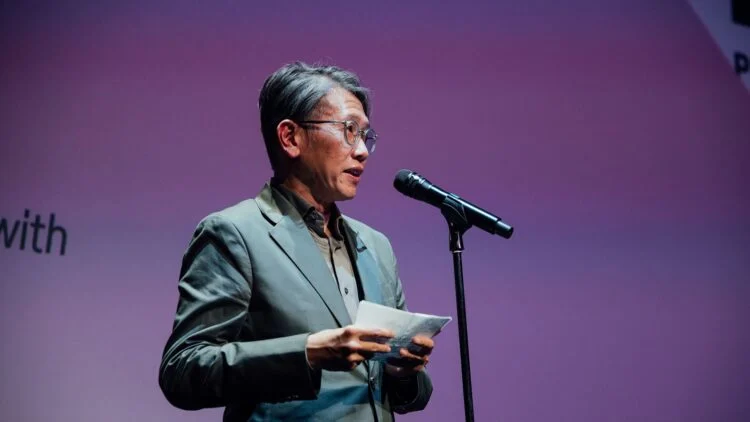
If you live in New York, you know this is the best time of year for filmgoing; if you don’t, you probably realize such and just wish you were here. The 64th New York Film Festival begins this Friday, September 25, and runs a little over two weeks, accounting for encores that are appreciable and often still insufficient for seeing everything on offer at Lincoln Center. I can speak from experience that seeing as much as you want—or, let’s be honest, seeing even more than you wish—is like a full-time job. Imagine the task of being its architect.
That man is Dennis Lim, with whom I spoke last year on the eve of the 63rd edition. Dennis has plenty more to say as this year begins, not least on the theme of sorts that has emerged from our dystopian moment. This conversation is not doom and gloom, though—by his read, cinema is in a strong-enough place that there’s reason to be hopeful, even cherish the medium. Plus: there’s always Hong Sangsoo.
Listen to our read our conversation below and and subscribe here.
Music courtesy of Lex Walton: “Love Theme from an Unreleased Film” from the album Giving It Up.
The Film Stage: When we last spoke, it was the Monday before the festival started. You had given me kind of a rundown of what that week was like, but what is it 10 days prior, just about two weeks before it starts? What was your day like today?
Dennis Lim: Well, today I started with being on a panel for this Critics Academy that FLC and Film Comment run. It’s for younger emerging critics. I sat on that panel with a couple of colleagues. And then I’ve just been doing a bunch of interviews. I think you’re maybe the fourth person I’m speaking to today. And had a couple of internal meetings as well—just planning ahead, looking ahead to like some events that might be happening during the festival, figuring out all kinds of logistical questions. Yeah, not so dissimilar from one week out, honestly. This whole stretch is a bit of a blur.
Yeah.
It’s just one thing after another; things keep coming up.
Have you found it gets easier with each passing year?
No. [Laughs] For some reason, no. I actually said the exact opposite—for some reason, it gets harder. I don’t know why. I don’t know. This year was complicated. I think it was complicated because… well, it was probably clear from the outside to anybody following: we had a good number of late additions. We announced all of the sections, the section announcements all went out, and then we had a few more films that had to be announced late, and they were all for very different reasons, very different circumstances. That just meant, you know, more involved and prolonged conversations for each of them.
Nathan Fielder and Lance Oppenheim’s You Can See Everything, you said?
Yeah, we announced that, I think, last week.
When did you see that film in particular?
When did I see that? A couple of months ago. July, maybe.
Okay. Is it a similar timeline with Paul Thomas Anderson’s film? Did you see that also about a couple of months ago?
Around then. Yeah, I think I might have seen that a little bit earlier. But yeah: obviously we draw on the films that are from the first part of the year—the Berlin, Cannes, Sundance films—and then everything else that comes in, we typically see in June, July. We typically finalize programming in July. There was obviously a lot of cast secrecy, and the existence of the film wasn’t even known until it premiered—or, I should say, had only been rumored.
Is there a different kind of attitude or approach to something like the Fielder film or the PTA film, in that maybe there’s a certain privilege being extended to it because you’re seeing it later as the program is nearly finalized? And does that create a different environment? I imagine it could be potentially a tad awkward if they bring you the film at this late stage…
Mmm. And we don’t take it?
Yeah, and you decide actually we don’t like this.
Not commenting on films that we don’t program, but we did see some other films late in the process and they’re not in the program. So… [Laughs]
Sure, yeah—one case where 2 plus 2 equals 4. The Fielder movie, I think there’s something about that topic and that filmmaker which ties into something that I’d wanted to ask you. I asked somebody, “What is something that Dennis hates to talk about?” And he said you hate talking about the festival as a set theme or reflecting themes of a given year.
There are things I hate more than that, but yeah. [Laughs] Sure. That is true.

Photo by Sean DiSerio. Courtesy of Film at Lincoln Center.
That’s like shooting a moving target with your eyes closed. But I did find your statement interesting when the Main Slate was announced, where you said: “it’s hard to recall a prior Main Slate in which the state of the world has been urgently reflected in so many creative ways.” You called it “a vivid picture of what our present looks, sounds, and feels like.” So without asking you to define a theme or to fit various movies into this—maybe asking this from a slightly aslant angle—how have you found this year, in the selection process, your relationship with the moving-image format affected by the world around us? Maybe what we see on our phones and in our computers, which is much more serious, much more grave. Does that beg a question about how useful cinema is as something that exists in the world?
Whenever I have to put out that release and write the quote that sort of sums up the program, I guess that’s when any thematic idea starts to crystallize. And I think it’s actually pretty clear here. It doesn’t apply to every single film in the lineup, but I do think that many of the films, including many of the strongest films, are just attempts to reckon with the world—whether it’s to document it or reflect, refract it, just ask questions about it. That comes across in a very wide range of the lineup. So maybe I am more comfortable than usual saying that there is a theme this year, I do think that is a theme.
I see it in films like—I think these are going to be some of the, let’s say, most acclaimed arthouse films of the year—Hamaguchi’s film, Lee Chang-dong’s, Mike Leigh’s. I mean, these are all films that really grapple with the difficulties of the contemporary world. Even a film, I think, like Dreamed Adventure asks questions about Europe from a very particular place—like, right on the margins. I think a film like Fatherland is looking at… it’s a period film, a moment in time, but one that has a lot to say about the present. And this isn’t even looking at some of the documentaries that are in the program, like My Undesirable Friends or NAZA or 14th.
But look: I think the state of the world is oppressively horrible right now. I just don’t know [Laughs] who would dispute that. So of course I think interesting filmmakers will want to tackle that.
I guess I’m wondering as you say this: is it then a comfort to be in a dark theater all day? Or do you sometimes feel like there is a lesser effect of it if you’re bringing what you see and feel in the outside world into the theater and then it’s being reflected back at you?
I don’t know. I think it’s an interesting question, but it really does depend on the film. Actually, let me try to understand your question a bit better. Are you asking whether cinema provides some kind of solace? Even if it’s a film that reflects the state of the world?
Yes.
Yeah, I would say so. I don’t know; it’s moving for me. I was deeply moved by the Hamaguchi film because I felt like this film really is asking some very pointed questions—a directness about it. As emblematic in that scene in the middle of the film where there’s a literal whiteboard and a lecture unfolds. This film is very directly, frontally tackling this question of what it means to relate to one another in a precarious late-capitalist world.
Yeah, I don’t know. For me, it is moving to see these films. Lee Chang-dong’s new film for that reason, too. I think it’s a film that really tries to contain so many questions about labor and class and art-making and desire; I feel like it’s just a very full, very abundant film. It’s nice to know, right? That there are good artists in this shared reality of ours who are asking interesting questions about it. I feel the same way seeing—it’s really all across the lineup—Lisandro Alonso’s film Double Freedom.
This film by Isabelle Stever [I Rarely Wake Up Dreaming] that I think is a really different kind of film about the situation in Ukraine, sort of seen through this relationship between a young queer couple. Long way to say that: yes, for me there is something helpful. I don’t want to say that it’s “therapeutic” or anything like that, but to see that films are acknowledging contemporary difficulties and working through them in some way is meaningful and moving.

NAZA
You were probably one of the first people in the world to see NAZA, a film that I think came as a surprise, and maybe the conditions of how it was made and what it’s about necessitated secrecy. I saw you post yesterday—someone as brilliant as yourself having to know what’s happening on Twitter makes me sad—about the controversy…
Just an occupational hazard of this time of year.
Just because of what you’re saying and because of this attention the film has generated, what were some of your thoughts on or reactions to the film as both a piece of cinema and something that is about the world today?
My reactions, or the reactions of the people who haven’t [Laughs] seen it?
Your reaction to the film.
My reaction to the film is that it contains important investigative journalism and is also a powerful piece of cinema. A lot of the revelations in the film have been reported by several outlets, including The Guardian—where Yuval Abraham, one of the filmmakers, publishes—so after seeing the film, I did go back and read some of these reports. So yeah: there’s definitely some overlap.
This isn’t entirely new news, but I think the film shows you what cinema can do. I think there’s something different about hearing these testimonies and these accounts from people. Just everything—the voice, the gesture, the body language of the person speaking gives a different weight to information. It’s a film that transcends the information that is being imparted to you. And I posted that out of frustration that this film has already generated so much predictably stupid discourse from people who haven’t seen it. Alarming, actually.
Obviously, you’ve seen what’s happened with the filmmakers being threatened, the citizenship status again, and then just this endless online debate unfolding between people who may never see the film because they’ve discounted it for whatever reason. But yeah, maybe back to what you were saying earlier: this was a film that I’ve thought about a lot since I saw it. And it was yet another film, like the Nathan Fielder and Lance Oppenheim film, whose existence was not revealed to the world and had to remain secret, but for very different reasons. In this case, I don’t want to say too much, but I think I can reveal that I saw it under very secretive, almost cloak-and-dagger-like circumstances.
I think I’m just grateful for the trust of the filmmakers—that they were willing to share that film with us early on. Discourse is maddening and misguided in so many ways, but I hope a festival like ours can… we’re not going to have a deep conversation about it in a 20-minute Q&A, but I feel like hopefully a festival like ours at least can create a meaningful context for this film. I mean, we’re speaking on Tuesday and the film press-screens here tomorrow, so I’m also very curious how it will be received. I think it’s already been written about very eloquently by a lot of critics in Venice.
Without having information in front of me, I’m not sure which section of the festival the film is playing in. And last year you talked about wanting the sections to be a bit more porous than in years past, where movies that are in Currents could be in the Main Slate, and vice versa.
Yeah.
This year almost seems that twofold or threefold, where a number of the movies were announced for the Main Slate, and I thought I had my ear to the ground with current cinema, and it turns out I didn’t. Because many of these films just surprised me for their existence. I guess I’d like to hear you talk a little bit about that—if there was anything special about this year’s Main Slate selection that geared you towards films that maybe in years past would have been more expected in the Currents section.
Mmm. But at the same time, we’ve also put filmmakers who are fairly established, like Carlos Reygadas and Bruno Dumont, in the Currents section this year. So I feel like, back to the point that we discussed last year, there are different committees for each section. The Main Slate and Spotlight share a committee, and I work with all the teams. Some films multiple committees see and weigh in on and we make the call. I sometimes try to gauge how each group feels about the film and also look at how that section comes together. The Reygadas film could have worked in Main Slate—he’s a major filmmaker—but I also feel like there’s something about putting this film in Currents because it’s formally radical work. So why not put it there?
We get a lot of questions often about why a film lands in Spotlight, because Spotlight is a section that we created to expand the purview of the festival, to expand the palette—to show, you might think that it wouldn’t typically have a new Godzilla film or a concert film like we have this year with Cameron Winter and Ingrid Caven. So Spotlight is there to expand the offerings of the festival. Currents should feel like it’s an ever-evolving terrain, and the kinds of films you see in it should also have a certain kind of fluidity there.
In some ways, I think it’s not so hard to forecast the festival and figure out what we might show. We have a prolific critic, Justin Chang, on our team, and Justin writes regularly so people know what he likes. I will do a podcast here and there on Film Comment, and I don’t really go out of my way to make my preferences secret, and you’ve seen the track record. So people will have a good sense of what we might show if you show them the lineups from Cannes and Venice and all that. But I also think it’s important to keep things a little bit unpredictable for our sakes as much as anything else—to put in a filmmaker that is new to the program, new to us.
We have a first-time feature filmmaker in the Main Slate, Marine Atlan with La Gradiva, which I think is an incredibly impressive first film. A filmmaker I’ve always been kind of intrigued by, but Mani Haghighi’s documentary [I Deserve a Lover Whose Every Rise Sets Fiery Dooms Raging Across the Skies] that we’re showing in the Main Slate. Isabelle Stever: a filmmaker I also found interesting. Ryan Ferko and Titakovi, filmmakers that we showed in New Directors many years ago, but I’m really happy to welcome them to the festival. I think all of that is to keep the slate feeling fresh and to give the sense that we are renewing the people who are in it.

Photo by Mettie Ostrowski. Courtesy of Film at Lincoln Center.
Well, that leads to a question I kind of want to ask, which is: can you imagine a Hong Sangsoo movie you wouldn’t want to program?
You know, I actually have been wondering this. Probably, yeah. I don’t like them all equally.
Oh no, definitely not. I think, with this project, liking them equally is an idea that’s so far gone at this point.
Yeah. But I don’t know. In some ways… maybe that was a disingenuous answer, because I am so convinced that it is one film. It is one project, and every film just adds to this massive, ongoing film in progress. So I don’t know; he seems to do it in enough ways every time. I actually think the two from this year are among two of my favorite recent Hongs. I actually went back and—just two weeks ago, Fireflies is doing a second edition of the book I wrote on Hong Sangsoo’s cinema [Tale of Cinema]. This was an opportunity… they asked if I wanted to write a little extra, an introduction, and I decided, in the end, to write an afterword because it made more sense.
When I had written that book—which was part of a series of monographs about specific films—I had set myself this private challenge that I would write about every Hong film that he had made up until that point, just to prove the point that you cannot consider any single Hong film in isolation. They all relate to one another. So it makes sense to continue by writing… so yeah: I just rewatched the last eight films, and they hold up, and I think the two we’re showing are among my favorites. Have you seen them?
No, I’m going to be seeing them this week.
The Day She Returns I’m maybe especially fond of because I feel like this is one that people are possibly likeliest to dismiss because it’s so minimal. It’s one that he filmed in four days, and it’s just an interview and then another and then another. But I think it’s conceptually so smart. Anyway, that was a long answer to a Hong question, but I have been thinking about Hong a lot again recently.
The question was asked somewhat in jest, because I also…
Yeah, I know you feel the same way.
Yeah, I also would—even if it was, like, a career nadir, I would still want you to program it so I could see it in a theater, which is a rare opportunity with Hong for me, or at least it hasn’t been a common opportunity. I’ll put it that way.
Yeah, I’m grateful for it.
Last year there was a wonderful GQ profile of you and your fashion sense. For the reader, what are you wearing?
…a jacket. I don’t know what color I would consider… that’s a tan jacket. It’s a…
Yeah, tan, I guess. Yep.
And underneath it is a different shade of tan. It creates a very nice… they go together very well. I’m wearing a slovenly white T-shirt, but I’ll be better dressed at the festival. But do you have any new outfits, individual pieces for this year? Have you bought any clothing in the last year that you’re excited about—clothing, jewelry, glasses, anything?
Yeah, let’s talk about this and about films! Since that GQ piece, which was really sweet—Raymond [Ang] did a lovely job with it, I thought, despite my hesitations about wanting to do something like this. Yeah, I did go to the Tokyo Film Festival last year, where I believe you went as well, right?
I did.
Did you go there last year? Yeah, I read some of your coverage. And I always use that opportunity to do a little shopping, but yeah, I’m not… I’m going to start thinking about it in this coming week. The problem with this festival is: it’s 15 days of… it’s actually a 17- or 18-day festival, but I have to be up there 15 days in a row, and that can be a bit… it’s tough. It’s a bit of a challenge figuring out what to wear given the occasion. You’re out there with these stars who have big stylists and budgets.
Right, but they’re only writing about one person on that stage!
Not so sure about that! Yeah, I guess I feel more pressure this year thanks to GQ.
Oh, gosh, well I don’t want to put the pressure on you. I mean, I don’t recognize this ensemble you’re wearing right now, so you’re already bringing it.
Okay, good. I might use this during the festival, too.
Well, I’m going back to Tokyo this fall and I’ve already been looking at places to shop. So…
Okay. Send your list!
Maybe I’ll ask you for a couple of recommendations on the sly.
Happy to.
But we had agreed to half an hour. You’ve done so much today. This is like your fourth or fifth interview. If even one novel question was asked, then job well done. You certainly answered like there was…
I definitely didn’t get to talk about Hong in the other interviews! And no, it’s always a pleasure, Nick. I appreciate your thoughtfulness.
Thank you. I appreciate your thoughtfulness. Where does the time go? I can’t believe it’s already time again, but I’m excited to be back. Thank you for doing this again this year, and I’ll see you around. I hope at screenings.
Yeah, yeah, I’ll be around.
Great. All right, well enjoy the rest of your day.
Thanks, Nick. Take care.

Photo by Mettie Ostrowski. Courtesy of Film at Lincoln Center.