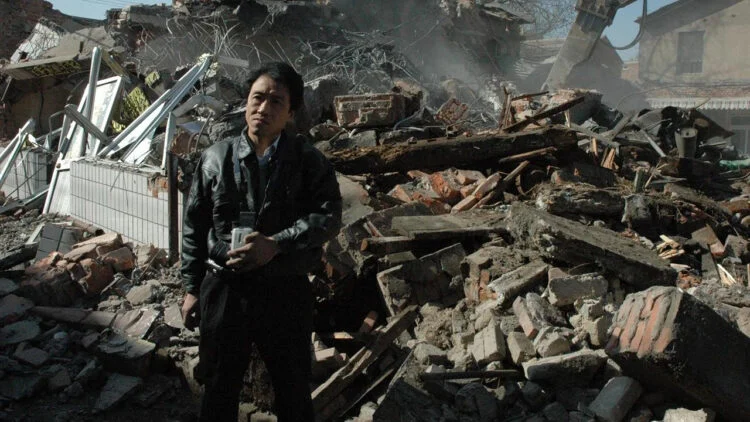
Twenty years after its premiere at MoMA, Ou Ning’s Meishi Street (2006) returns to New York, documenting residents’ resistance to the demolition of the Dashilar neighborhood ahead of the 2008 Beijing Olympics. Most of the film was shot by local restaurant owner Zhang Jinli, whom Ou taught to operate a camera and who led the grassroots charge against the forced displacement. Made in collaboration with artist Cao Fei and filmmaker Huang Weikai, the film remains a touchstone of Chinese independent documentary’s engagement with the country’s modernization projects, as well as a key project in Ou’s larger body of work bridging localism, urbanization, and rural reconstruction through communitarian media practices.
I met with director Ou Ning in Forest Hills ahead of Meishi Street’s screening at Anthology Film Archives on September 19, as part of the series Rubble on Screen: The Cinema of Demolition and Destruction, programmed by Mako Fukata and Sam Schiffer. The film will be preceded by Gordon Matta-Clark’s Splitting (1974), a nod to Ou Ning’s interest in “anarchitecture.”
The Film Stage: Meishi Street maintains a pattern within your practice of using participatory methods to investigate rural and urban spatial politics, following San Yuan Li (2003) and preceding Bishan Project (2011-2016).
Ou Ning: Yes, San Yuan Li is my first film. It was produced in a collective way with the members of U-thèque, a film and video organization I founded in 1999. At that time, we did not know how to make a film, so we learned from the screenings we organized every week. The German Federal Cultural Foundation (Kulturstiftung des Bundes) started a project called Beijing Case, before the 2008 Olympic Games, they invited me and Cao Fei as fellows and hoped we could make a kind of film similar to San Yuan Li. Beijing started a lot of development just because of the Olympics, but it was different from Guangzhou’s urbanization of suburban villages in the 1980s and 1990s. So we could not find an urban village like Sanyuanli in Beijing.
Instead, I was surprised to find a slum in front of Tiananmen Square. So that is when we started focusing on Dashilar, which was slated for demolition and renewal to embrace the Olympics, and finally we decided to focus on just one street, Meishi Street. Through Dashilar, I understood, the reason why the city has slums was because farmers could not survive the agricultural decline in rural areas, so they came to the city to find jobs, but they could not afford the high cost of city life and had to live in the slums. So, I traced the urban issues to rural issues and kicked off the Bishan Commune, a long-term project focused on rural reconstruction.
This kind of collective approach can be very helpful for illuminating the politics of media or cultural infrastructure. How did you develop the participatory methods you use to investigate these topics?
I grew up in Southern China in the 1980s. At that time there was the avant-garde poetry movement. Young poets could not publish in the official journals, so they had to found underground magazines. Young people had a lot of unofficial publications and underground groups; they gathered together in different cities and connected with each other to shape a nationwide network. Let’s say, it’s something like a mafia. I took part in this poetry movement and inherited my interest in jie she (结社), that means “forming an association or a society”—you are independent from the official political system, or the commercial mainstream, you don’t take their funding, you do everything yourself with your comrades. INDEPENDENT is one important key adjective for me, together with COMMUNITARIAN, when I learned it in my later research project on intentional communities and utopian practices. So, U-thèque was an independent group, producing film in a collective way. It comes from my poetry movement experience in 1980s.
The film centers on Zhang Jinli. How did he get involved in the film?
When we decided to focus on Dashilar area, we walked around in this area every day, with cameras, but still found it very difficult to get inside the community. One day, early morning, I was by myself. I wanted to take some shots of the early landscape of Meishi Street. Someone came up to me because I was carrying a camera. That was Zhang Jinli, he saw me with a camera and thought I was a journalist. His restaurant was going to be demolished, so he needed the help of journalists to share his story. I pretended to be a journalist and interviewed him. Later, I read a book by William Whyte called Street Corner Society, published in 1943, a sociology book on participatory research about an Italian slum in the North End of Boston. Whyte could not find a way to get into the community but met a local young guy on the street and made him his assistant, to interview people.
I got inspiration from that book, and Zhang Jinli became my “informant.” After that, I got the idea to give him a camera. I was thinking of the camera as a kind of weapon. You see in the film, when he hung banners on his restaurant, the police came to tell him to take them down. Zhang Jinli pointed the camera at the police, and then they left him alone, so Zhang Jinli realized the camera was quite powerful.
The camera was doing something other than just creating images, it changed the relations between people in real time.
Right. From the camera, I developed the idea of an “alternative archive.” Normally, in China, history has only one official version: the narrative of the Party. So ordinary people don’t have their voices heard. History should have multiple versions, especially versions written by ordinary people. The camera empowers ordinary people, giving them a medium to document their immediate lives, express their political opinion, develop their own narrative, an alternative archive separate from the official archive. Meishi Street is the story of how ordinary people can develop their narrative and their history.
What does it mean that you pretended to be a journalist? Within that media environment, what was the difference between a journalist and a documentary filmmaker?
At that time, I don’t think Zhang Jinli knew anything about Chinese independent documentary film. Ordinary people had no opportunity to see any independent documentary filmmaking. The only documentary they would have seen would be through the TV, especially CCTV, official documentaries. The first-generation of Chinese independent documentary filmmakers, like Wu Wenguang, used to work from the state-owned TV system. At that time, CCTV had some programs about ordinary people, focusing on social issues. Zhang Jinli only knew of this kind of journalist. Social media and the internet were not that popular, journalists were the only people who could really bring your story to a wider audience. So, I pretended to be a journalist, just for one day, and after that I told him, I’m making a documentary film that is different from TVs. I also introduced the internet and blogs to him. He learned very fast. He had a blog later, where he would post images of the demolition. He also, after the project, bought a camera himself.
Is that blog still online?
No, it’s no longer online. But, at that time, blogs were very popular for educated people. Zhang Jinli is one of the early adopters among ordinary people.
Much of the critical discussion around Meishi Street has to do with authorship. You handed the camera over to Zhang Jinli, but you, Cao Fei, and Huang Weikai also participated in shooting the film, which then you and Cao Fei edited. How were you thinking through those different aspects of authorship?
In the film there are three families, but it mostly focuses on Zhang Jinli, and I told him he can shoot or give the camera to other families. Ultimately, only Zhang Jinli used the camera. Of the footage, 30% is our team of filmmakers and 70% is Jinli’s. Today, if I had the opportunity to do the same thing, I would get Zhang Jinli to learn editing so he can craft the story by himself. At that time, I didn’t have the time to teach him. The project had a deadline, because the German Federal Cultural Foundation was going to have an exhibition in Beijing and in Kassel in Germany, I had to finish the film. It would be more interesting if the whole film was shot and edited and narrated by Zhang Jinli, if it was his story. That would be more radical. I would like to transfer the role of director to him, and just think of myself as a facilitator, to get his voice louder; or as a bridge, to connect possibilities and make things happen.
I do think your team’s perspective was important, though. I think of the final scene where we see Zhang Jinli’s tears. This image is so moving and powerful. If only he was filming, we wouldn’t see that. What kind of perspective do you think you, Cao Fei, and Huang Weikai brought to the project?
Our team’s footage was very important, actually. The demolition day was very chaotic. The bulldozers, the police, the local government, the medical team, it’s all a huge event. We needed a collective effort to document that day, that was how we were able to document Jinli’s tears. That is the good thing about collective work, otherwise, we couldn’t have had this scene. Although our team’s cinematography might be slightly more professional than Zhang Jinli’s, we are all self-taught and remain far from meeting the standards of the film industry. Yet, when documenting an unpredictable social event, image quality matters less than capturing a comprehensive, start-to-finish record.
Having long been engaged in sound study, I invited sound artists with extensive field-recording experience to work on both films; however, amidst the chaos of the forced demolition, the audio captured directly by the camera was powerful enough on its own: the roar of the bulldozers not only moved Zhang Jinli to tears but also tore at our hearts. I let that sound continue right through to the final switch-to-black, using that image-free screen to expose the violence of the sound until the film ended.
Cao Fei and Huang Weikai also have their own artistic and filmic practices too. What was it like working with them?
Cao Fei and I have an agreement. We are co-authors of San Yuan Li, but for Meishi Street, I am the director and she is a cinematographer and editor, Huang Weikai is also a cinematographer. He is a highly observant cinematographer and a key member of our team; the footage he shot features prominently in both films. When for San Yuan Li, we all worked as cinematographers, because everyone had a camera. we would all go out to shoot on our own, then over the weekend have a meeting to watch the footage and discuss what we will do the next week.
We repeated this week by week for a year. The narrative idea is mine, but Cao Fei has very good editing sense to make the image catch the rhythm of the music. When for Meishi Street, Cao Fei was becoming busy for her own projects, it was mainly myself to communicate with Zhang Jinli. I collected and viewed his footage month by month, discussed what and how he should shoot in the next step…but when the demolition day came, we all showed up.
With those meetings, how did your approach to filming change over the course of production?
Documentary is very challenging, you cannot have a plan, you don’t know what’s going to happen week to week. We spent half a year shooting Dashilar, we didn’t know there would be someone like Zhang Jinli. The project changed, it found its direction, and we totally changed to focus on him. We have so much footage, the film is 100 to 1. That is the reason, after these two films, I did not make another documentary film. It costs too much time.
How did you craft the scenes and the arc the film takes while editing?
I don’t want people to just see Zhang Jinli, I want people to understand what supported him during his protest. He practiced martial arts, he sings karaoke, he uses Beijing humor, he has a girlfriend, his family, his daughter. To protest, one person is not enough, individual protest could not sustain a movement. So, I believe he got a lot of support from his friends, family, the resources he collected.
Yeah, something I love in the film is all the scenes of him singing.
The singing is very important for him. He always used revolutionary heritage, the slogans of the Cultural Revolution, the policies of the contemporary CCP, then sang the old revolutionary songs to protest the city regeneration project. The slogans that he used are so creative. He used language from the Cultural Revolution to protest for his property in an ironic way. He used the communist party’s ideology to criticize the communist party.
How did you balance the story about Zhang Jinli and the broader story of the neighborhood?
The narrative includes two other families. I want people to compare the three families. One includes an old veteran, another is a radio host, and the third is Zhang Jinli. To compare these three cases, I want people to know Zhang Jinli’s protest lasted the longest, was the most creative, and can help us to articulate the idea of alternative archives, alternative histories.
This is a small detail, but when you introduced him in the film, he’s crawling out of that hole in the ground and the title says, “Restaurant Owner, Divorced.” Being divorced shapes one’s emotional landscape, ideas about private and public, and connection to home. It’s one of the first things we learn about him.
Wow, you noticed this detail. The reason why I highlighted this term is because in the later part of the documentary, there is footage about his girlfriend. We don’t have any footage talking about his ex-wife. We added this term “divorced” so we could contextualize who that woman is. She is so important for him.
When the film began to screen in China, was Zhang Jinli’s life affected at all by his participation?
The film was introduced by Barbara London and premiered at MoMA in 2006. One of my friends in New York suggested us to hold it and not screen it in China for at least one year. I remember in 2007, I started to share it in China. The district government tried to contact me. Well, the government noticed that this film was screening a lot, they didn’t want Zhang Jinli’s case to become a big spectacle, so they tried to satisfy him. He did eventually get compensation. The local government offered him a property, not in the same area, because it was too expensive since the Olympics, but gave him a property in another location. Zhang Jinli refused and suggested cash compensation. This really changed him. After this documentary film, he became very active on the internet and interested in politics. He is my WeChat friend, and today, every day, he posts content that is quite sensitive.
Given that the content could be politically sensitive, what was the process of distributing the film?
Before the “world premiere” in MoMA, Andrew Gluckman and Weiwei Shannon, the founders of People’s Architecture, introduced our works to the film producer Karin Chien. Karin arranged a screening of San Yuan Li later in that year in NYU and came to meet us. That was the first time for her to see Chinese independent films. Following my introduction, Karin soon visited Beijing, where she met many filmmakers. In 2008, she founded dGenerate Films to distribute the Chinese independent films in North America, including San Yuan Li and Meishi Street. The two films are invited to screen mainly in international museums, galleries, film festivals and art biennales while the academic distribution in North America is handled by the dGenerate Films in the early period, recently by Icarus Films. They were sold and included in the collections of many libraries in the universities in North America. In China, the screenings are all underground, by some independent organizations.
There are many films from that time about urbanization and demolition, images of rubble common to Chinese cinema of the time. It becomes its own genre of urban cinema.
Yes, I was surprised to see the program at Anthology, connecting Meishi Street to Gordon Matta-Clark. In my essays, I wrote quite a lot about the urbanization process in China. One addressed the “anarchitecture” of Gordon Matta-Clark, comparing the urban regeneration project in the U.S. and China. Looking back at my film today, the demolitions of Zhang Jinli or Gordon Matta-Clark happened in different places but share the same issue. It is about how to uphold social justice when the public and private resources are re-distributed. How can people’s property be protected? The U.S. has an earlier modernization project than China but face the same issues in different historical periods. Now, demolition is not caused by radical urbanization, it is caused by militarism and war.
Can you say more about your interest in “anarchitecture?”
I have been interested in anarchism for a long time, especially the idea and practice of mutual aid. I see that mutual aid happens a lot in the countryside in China. People help each other, they do not need currency, they exchange labor. I think this is a very beautiful, ideal society. But for Gordon Matta-Clark, “anarchitecture” is about destructive action as intervention: cutting or destroying the building with an anarchist approach to criticize injustice in the urban regeneration process. Of course, we cannot say Zhang Jinli is anarchist. But his protest has the same meaning as Matta-Clark. He tried to protest for his property; he used the street as a public space to express his political issue and criticized the governmental violence and the abuse of power during the urban regeneration process.
Now, we’re twenty years later and approaching the 2028 Olympics in LA. When you’re looking back on the project, what are your reflections?
San Yuan Li and Meishi Street document such an important time in China, a time of radical urbanization. Meishi Street focuses on demolition before the Beijing Olympics, and then after that is the Shanghai Expo in 2010. It was the most important years that China was presenting itself as an emergent superpower, a new empire. These two films document, from a grassroots perspective, the social costs associated with China’s rise, but to this day we still see no effort on the part of the Chinese government to pursue or address the issue of transitional justice. I was very happy I could do these projects in those years, especially presenting Zhang Jinli’s “upbeat protest” in Meishi Street—rather than simply dwelling on his suffering and misery, he has consistently maintained confidence and optimism, expressing protest and criticism through humor and creativity as he fights for the rights he deserves.
Looking back, this was a rarity among the many films about forced demolition from that era, and it remains a valuable reference for grassroots activism today. These two films followed the collectivism I inherited from the avant-garde poetry movement in the 1980s, but it also kicked off the Bishan Project and the projects of today. Now I’m thinking about making a film or writing a book based on the autonomous practices in Northeast China during the second world war, including the Korean anarchist immigrants, Manchurian bandits and a family goldmine kingdom. I’m also working toward the opening of the Northeast Asia Art Archive space in Forest Hills next year.
Last question: what do you sing at karaoke?
I’m Cantonese, so Canto-pop from 1980s is my favorite. Kenneth Choi Fung-Wah (蔡楓華) or Terence Choi Kwok Kuen (蔡國權), there’s so many. I’ve never gone to karaoke in New York, but in China, I sing those 1980s songs every time, people say, “you’re an old man.”
Meishi Street screens at Anthology Film Archives on September 19.