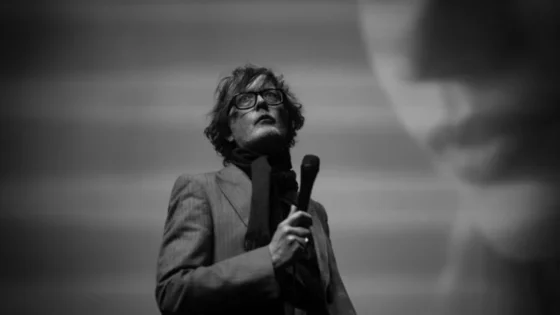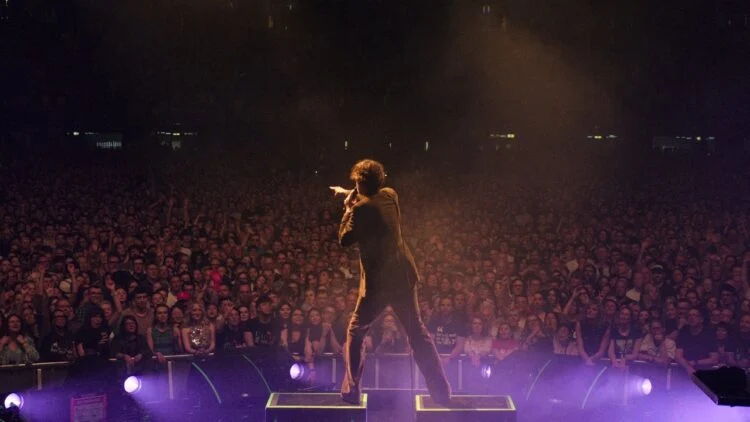
At the top of our interview, director Garth Jennings pulls the laptop in close. He’s seated next to the subject of his new film: Jarvis Cocker, legendary Pulp frontman. We are Zooming to discuss their new film, Pulp: What Do You Do for an Encore?, a combo concert film/documentary on the origins of the best band of the ‘90s, and which is now streaming on MUBI. What follows is our cheeky conversation about the film, the Pulp reunion, ‘90s nostalgia, virtual ABBA, and their (fake?) new anti-AI slop motivational video series.
Garth Jennings: I’m just gonna bring you in a little bit. Intimacy, that’s what we’re after.
The Film Stage: Even if we’re digital, we gotta get a little intimate here.
Garth: Bridge the gap.
We’re doing this interview on Zoom. That’s very exciting to me, but as someone born in the mid-’90s, my mind can’t help but go to a place where this is the ‘90s, I have some magazine’s credit card, and we get to have a steak dinner and do some designer drugs for this interview. As someone who’s a 31-year-old musician, can you tell me if there’s anything better about being an artist now than in the ‘90s? Any negatives we’ve missed out on?
Jarvis Cocker: Well, I mean, yeah, there’s certainly a bit of ‘90s nostalgia going on. Like in the UK next week, there’s an exhibition at Tate Britain opening called ‘90s.In my interview for that, I said that the ‘90s is when the best and worst things happened to me. And they were both the same thing, I suppose. The best thing was, in the UK at least, there was this moment where bands that would normally just have been called “indie bands” were, for some reason, allowed to be major bands as well. And that felt like a very exciting moment: that there was gonna be a revolution and culture was gonna get better and it would be the ‘60s again.
And then when we actually did become famous I realized it wasn’t gonna be the ‘60s again. It was the ‘90s. You know? We elected a Labor government for the first time in a long time and we suddenly realized that that idea of a socialist government had disappeared. So it was a bit of a disillusioning time. But my main lesson that I got from that was that you can’t really get hung up on that, you know? Like I said: I wanted it to be the ‘60s because all the TV I watched when I was a kid made me feel that the world was much more exciting then. But the only—I’m gonna sound like I’ve been going to some kind of mental religious thing or whatever—the only time you have is now. So rather than trying to make something that was in the past happen again, you have to try to make something happen now. And maybe that’s what could be good about now: that things are so bad that it would be great for people to make something for themselves.
Garth: I totally agree with that! Yeah.
Yeah. Hey, I agree. I mean, I like the now, too—at least because I get to be alive now.
Jarvis: Right!
As far as the documentary, is there anything awkward about making it? Like literally: when you call up relatives for old pictures and videos, how prepared are they?
Jarvis: Well, I supplied some of the archive. For some reason, I had been given all the tapes from a BBC special that was made on Pulp back in 1995. They’re on Betamax, so I’d never seen them.
Garth: The footage came from everywhere. A lot that Jarvis had, and Mark Webber had, and home videos. And then also we went around raiding the TV stations’ archives and there’s a lot, and it was fantastic. The only trouble with that process is it’s sort of like a guilty pleasure because, for instance, you find a clip of a band on Top of the Pops and then you watch that clip to make sure it’s good, but then instead of stopping, there and going on to the next thing you can’t help but watch the whole show because it’s fascinating. Like, you know, when you go through your old photographs and you’re only supposed to fold em up, put ‘em in a book or something, and you just stop and go “remember that barbecue?” And it was like that going through all the archive material. It was just extraordinary to see that time again, be back in that time. And there were things that we found of the band that I’d never seen before. Not just their own personal footage, which of course I wouldn’t have seen, but stuff on TV that was amazing, that came from different countries as well.
Like the children’s pirate show that Pulp appeared on. That was something I hadn’t seen.
Jarvis: I really wish I’d never seen it. [Laughs] But that was, you know, there was no way to see that, because that show was called Live & Kicking, and it was on on Saturday morning for kids, and it was live. So, you know, you did it, and then you went off to play a concert or whatever. Never got to see it.
Garth: There was no YouTube to upload it forever. So it’s, yeah, it was a lot of discovery. It must have been quite odd for you [Jarvis], seeing all that stuff that you’d never seen before.
Jarvis: But that was the reason that I… I say in the film, half-seriously, that it was this thing of wanting to realize my childhood dream of living on the TV, like living in TV land, and I thought that if I said yes to every offer that we were given to go on TV, then eventually they’d say, “Oh, you want to live here, don’t you?” And I’d say, “Yeah, where’s the apartment?” It never came. I had to learn to live in the real world just like everybody else.
Garth, you designed Pulp’s stage show before there was a movie?
Garth: What happened was: I reached out to Jarvis when I heard there was a rumor that there was gonna be a tour just to say how excited I was, and if there’s any chance of filming I’d love to give it a shot. Jarvis came to meet me, I thought to talk about that, but actually we ended up talking about: how would you stage a show like this? If it’s going to be an encore, what should it look like? How should it feel? And so I got involved in that way.
Jarvis: We’d both seen this [virtual] ABBA show that’s on in London at the moment called ABBA Voyage. Which is where it looks like the young ‘70s ABBA are all performing onstage. So we both really enjoyed that show and how it worked, and in a weird way it made you realize that the band were important, because there were bits where it went to a full-video-screen thing and they weren’t so interesting. But when you had the little figures performing, you really rooted for them.
Garth: It galvanized everyone. I think it’s a 3,000-seater arena for ABBA. Everyone’s looking at them and we’re all rooting for them. We were cheering and singing along. It was amazing.
Jarvis: You know, everybody knew that they weren’t actually there.
Garth: It didn’t matter. We wanted them to be there more than we wanted to accept that they weren’t. And that’s what audiences do, don’t they? They bring it to life.
Jarvis: So I think that that had a big impact on how we then put the show together. What you realise there was: the audience made it happen. There was no band actually performing; they weren’t “giving their all.” They’d given their all in the capture stage, but there was nothing there. And yet the belief of the audience made it work. So that told [us] something very profound about how concerts work, and so I think it got us off on the right foot.
Garth: It did. Also, just that idea of putting on a show, a really good show. And having a real curtain and making a grand entrance and not stopping, that every aspect of it would be thought through. And yet there was still all this spontaneity within that. There’s nothing like working on something live. It’s been one of the highlights not just of my career but of my whole life working on the Pulp show. I’m not just saying that because he’s sitting here. My wife would back me up; she would remember me coming home saying “this is the greatest thing ever.”
So to get this straight: the ABBA Voyage. Is this, like, a 3D thing?
Garth: Yes! How it’s actually done it’s very-high-definition screens, but they’re done in such a way —
Jarvis: No, no, because sometimes they walk! They walk to the piano and play. Or maybe I’m just believing that?
Garth: No that’s good! In a way I sorta don’t wanna tell you, because it will break the spell. Actually, even though I’ve seen it three times now, every time I just completely… it’s like a puppet show. When they first appear, you’re going, “Oh, there’s the wires. There’s the man, and he’s moving it.” But immediately, because it’s done artfully, you just invest in the trick that’s being performed. Done well, you just go with it. And that’s the ABBA Voyage. It’s the best magic trick ever because it is just imagery on screens at 120 frames per second.
Jarvis: But they were casting a shadow on the stage, that was…?
Garth: Yeah, but the stage was just a reflective surface, so it’s just reflecting the screen.
Jarvis: Right.
Garth: It’s brilliant!
Listen, if it comes to New York, I’ll see it!
Jarvis: Well, I think they’re gonna start doing it all over. I was told that KISS was gonna be the second one, which I wasn’t so excited about. Obviously they’ll be trying to do an Elvis one. I bet the Rolling Stones would do it; they don’t often turn down a chance to earn something. [Laughs]
The KISS voyage I’d be a little afraid of myself. Incidentally, to settle a bet: the Sunrise bit during “Sunrise,” was that a reference to Ken Russell’s Tommy?
Garth: No, I think that most of that all came from Jarvis. You do love circles.
Jarvis: I do, yeah.
Garth: Lots of circles. And also it’s “Sunrise.” It’s just sometimes you want to do as little as possible to set up a song. You also cut a really… what’s the word? Not “significant.” Your silhouette is very identifiable.
Jarvis: Well, and at my age, a silhouette is the way that I look the best. I think I prefer to see myself in silhouette than full-on. [Laughs]
Garth: But it was lovely to perform two sunrises. That was the idea: to bring up the sun, and then it goes away and a real one comes up, and that light source, it’s like something they would have used at the end of Close Encounters. It is a real, blinding, probably incredibly dangerous light which Jarvis, at the end of it, he has to turn around before the very last beat, because you could get a tan off that.
Jarvis: It is like you’re getting cooked.
Garth: He’s getting fried. Yeah.
Jarvis, you note in the doc that there was a 14-year gap between first exposure on the John Peel show and your first hit. You were a little older than some of your peers in the ‘90s, and I feel like that’s incorporated into your writing style. This O2 show was your biggest ever, which is 30 years or so into your career. This implies that some of your appeal comes from a maturity in your perspective, which is a quality I also associate with artists like Leonard Cohen and Serge Gainsbourg. How consciously did you shape that perspective? When did you feel that start to come out in your writing?
Jarvis: I don’t know. But you know, both those people you mentioned, I really rate them. And I also like the way—especially like, say, Leonard Cohen and also David Bowie—they worked until they died. Leonard Cohen was working a couple of months before he passed away, and Bowie released Blackstar, and two days after it came out, he died. You use creativity; you’re writing about your life, but it also gives you life because I think it gives you something to do. Not like a hobby, but that you have a project that you’re working on, hope you get to the end of it. So there’s always something to write about, I hope. I was writing a couple of things whilst we’ve been touring, but it’s always hard to do that. I’ll have to see. But I think you just have to look around and then see what you’re thinking about, what you’re gonna write about.
I texted my friend Leah Hennessy, who’s a great musician, and told her that I’m doing this interview. She has a question: as a teenager, you dreamed of Pulp as celebrating the excess, the waste of society, the literal “pulp.” Do you see any value in the pulp of contemporary culture? Is there any redemption that you see in the modern trash?
Jarvis: Well, I suppose “modern trash”… we’re in a weird position now, aren’t we, with—I’ve heard a phrase—“AI slop.” Whole aspects of modern culture are coming from AI, and that’s… that’s weird, because, you know, everybody says AI is terrible and it obviously is in a lot of respects.
In terms of creativity, I called the band Pulp because all the stuff that I watched when I was a kid was considered to be throwaway rubbish—you know, like Batman and comic books and all these kind of things—but I found that I liked them. And often the more kind of throwaway aspects of modern culture are the bits that last. [Whereas], like, concept albums about dragons coming to free the world and all that kind of stuff is like: yeah, bye bye. Nobody’s listening anymore.
So whether AI will make some slop that defines the 2020s: I don’t know. I’m out of touch, I guess. You know, I haven’t really… the pop charts were a kind of form of religion for me as a child, and I’ve kind of lost touch with them. Around the mid-2000s. I don’t know what’s been #1 in the chart for at least a decade. How about you?
Garth: I’ve been making these Sing movies, so I’ve been listening to a lot of modern pop music. But I’m aware that it’s not like it used to be. I was exactly the same—you just used the word, like, “religiously” followed [the charts]. That was exactly how I felt about pop music. And now it feels more like: everyone has their own lane. And I liked it when everyone listened to everything. And the charts reflected that. They were bananas. You look back at the eclectic mix of things when I was growing up.
I don’t know, really. Hopefully the AI thing inspires people. The idea of “slop” sends people the other way, which is to put a premium on authenticity. The real thing just got more valuable, hopefully.
Jarvis: Yeah, I think it could. If all the kind of rubbish stuff is produced by a computer, then you have to then set your sights on producing something that can’t be done by a computer, so it might actually be an inspiration to people to up their game.
Garth: Up your game.
Jarvis: Come on, let’s up your game. Come on!
Garth: Come on!
Jarvis: I think we should be making motivational videos?
Garth: This is it. We should be in leotards going, “Up your game!” That’ll be it; it’ll come on the screen as we say it.
I’ll try to find some leotards for you guys. Yeah, up your game.
Garth: No more slop!
I think you guys got a side hustle here if you need it, you know? The Up Your Game series.
Jarvis: Yes.
Garth: It’ll be like Milli Vanilli meets motivational speakers, yeah.
Man, this is a dream come true. See, this is what we do it for, you know? I’d like to think I had a small part in you guys maybe finding a true passion.
Garth: The idea of what we’re doing next just got sorted out. Yeah.
I think we figured it out. Up Your Game.
Jarvis: Thank you, Matthew. Let’s all up our game.
Garth: Let’s leave this conversation knowing that that is what we’re gonna do.
Pulp: What Do You Do for an Encore? is now streaming on MUBI.