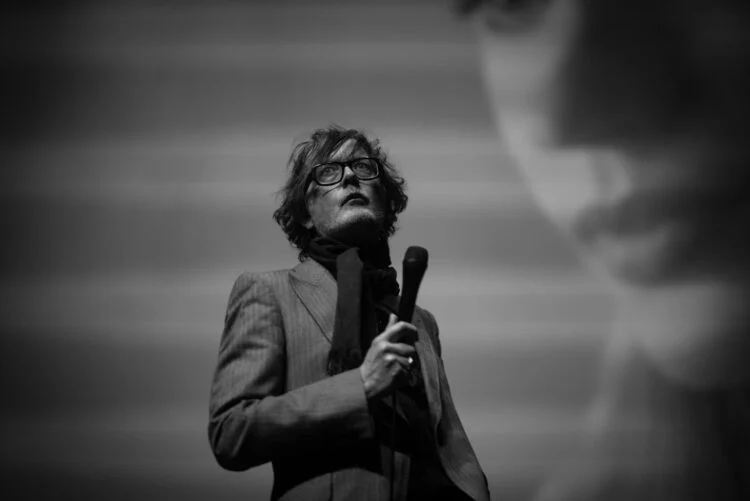

If you grew up with a well-worn CD of Pulp’s 1995 album Different Class, or discovered it at some point in the last three decades, then watching the band’s new documentary might cause your life to flash before your eyes. Pulp: What Do You Do for an Encore?, Garth Jennings’ film shot during the band’s triumphant June 2025 shows at London’s O2 Arena, captures a band at its effortlessly brilliant best. That’s no small feat when your first performance took place in the early ’80s. Lanky, lovably louche frontman Jarvis Cocker may look a bit older, but he’s clearly lost none of his wit (or dance moves).
Jennings’ film provides the answer to two of the great Pulp mysteries. First: why does the band have more worldwide popularity now than ever? Is it the William Shatner effect? The Cocker-Wes Anderson collaborations? The prescience of Cocker 2006’s solo track “Running the World”? It certainly helped that Olivia Rodrigo was spotted singing “Common People” atop then-boyfriend Louis Partridge’s shoulders at Glastonbury in 2025, and later used “Do You Remember the First Time?” in an Instagram post.
Second: what is it about Pulp that causes such intense devotion? For it seems there are few moderate Pulp fans. There are those who delight in every Jarvis Cocker hand jive and lyrical takedown; who adore seeing wizened Mark Webber, Nick Banks, and Candida Doyle onstage; who regularly replay His ‘n’ Hers, Different Class, This Is Hardcore, and the underrated We Love Life; and who bought 2025’s More on its first day of release. Then there’s the rest of the world.
As a Pulp fan, then, there’s a high likelihood that some of the most important moments of one’s past are innately linked with songs like “Common People,” “Disco 2000,” “Babies,” and “Do You Remember the First Time?” Yes, they’re bangers—then, now, forever. But the answer to both the questions asked above is best understood through the lyrics of “Mis-shapes,” the fourth song performed in Pulp: What Do You Do for an Encore? Cocker’s lyrics speak of “mis-shapes, mistakes, misfits” who “could end up with a smack in the mouth just for standing out.” Pulp is the soundtrack of misfits’ lives. And in the 30 years since that song’s release, misfits have gone mainstream. Perhaps there was no band better equipped for an embrace of the outsider.
What Do You Do for an Encore? captures the Pulp of today—after years of struggle (pre-His ‘n’ Hers), shocking mainstream success (Different Class era), crashing out (This Is Hardcore), wilderness years (We Love Life and a lengthy hiatus), a successful first reunion (from 2011-2013), and another hiatus. That band is relaxed, joyful, and pleased to go on a victory lap. Smartly, Encore intersperses the O2 Arena performances with archival footage and interviews, each narrated by Cocker. How did this strange group end up performing its 566th show before an audience of 20,000 fans in 2025? “That’s a long story,” Cocker purrs, “but I’ll tell you it, if you’ve got time.”
But first, the stage. Cocker may be known for his playful phrasing, but when he states, “This is a night you’ll remember for the rest of your life” as Encore begins, there’s no doubting his sincerity. “Spike Island,” the first single released from More, is a perfect statement of intent. “I was born to perform, it’s a calling,” Cocker sings. “I exist to do this, shouting and pointing.” Remarkably, “Spike Island” and the other More tracks performed here (“Grown Ups,” “A Sunset”) sound as if they’d slot nicely on any classic Pulp record.
After “Spike Island,” Cocker begins narrating the band’s story. His quest to live in the world he saw on TV as a child is a recurring theme, as is the idea of music as a refuge; he explains he “grabbed the three most unpopular kids in school and started a band.” Back to the music, Pulp sways into the once-controversial “Sorted for E’s & Wizz” and the original’s melancholy tone is stripped away for something warmer. A throbbing “Disco 2000” is accompanied by streamers falling from the rafters and the audience bathed in red. It wouldn’t be a Pulp song without pathos, and even a mass sing-along such as “Disco” includes lyrics like “you didn’t notice me at all.”
Cocker shares how an early version of the band scored a John Peel BBC session, but this did little to enhance the group’s status. What really slowed things down was Cocker’s falling-out-the-window-while-trying-to-impress-a-girl mishap. During his recovery, Cocker hit on the band’s unique sound: “Barry White + Eurodisco + Gritty Northern Realism = the Future.” Soon after came the development of what Cocker calls “the Pulp aesthetic”: “Sifting through the debris to find an alternative to the official narrative, using second-hand items to tell a brand new story.” That may sound like nonsense, but it seems logical after hearing those descriptions and watching the band perform “F.E.E.L.I.N.G.C.A.L.L.E.D.L.O.V.E.,” “Babies,” and “Do You Remember the First Time?”
Cocker speaks candidly about the band’s rise to music stardom and tabloid infamy (“We had scaled Mount Pop”) as well as the darkness that followed. In 2025, the title track to This Is Hardcore suggests the stately culmination of the band’s career to that point, and a prophetic study of a culture in decline. In 1997, however, it sounded to many like career suicide. (“The indie darlings have lost their common touch,” sneers a talking head of the time.) More difficulties were coming in the form of a long hiatus and, after a reunion, another hibernation and the death of longtime bassist Steve Mackey.
As performed in Encore, “Something Changed” feels like the entire Pulp story in one song. But, of course, “Common People” steals the show. Arguably the greatest song of the 1990s (it is at least top-five), it’s a tune so full of venomous wisdom, so musically ambitious, and so catchy that even William Shatner could not sully it. Jennings keeps the audience shots to a minimum, but when he does cut to them, especially during this song, they’re doing what you’d be doing—jumping in time with the music as Cocker points in their direction.
Moments like this make Encore a much more satisfying effort than 2014’s Pulp: A Film About Life, Death & Supermarkets, a pleasurable if unmemorable oddity that tied the band’s Sheffield past with its first reunion tour. Supermarkets felt incomplete and relied far too much on the viewpoints of Sheffielders not named Jarvis Cocker. It was a loving celebration of the ordinary (OK, common) people, but not the ultimate Pulp picture.
While Encore includes fleeting mentions of Oasis and Blur, and quite a few rapturous mid-90s UK music magazine covers, there is nary a mention of Britpop. Most surprising, though, is the absence of a name that’s invariably uttered in any history of the band: Michael Jackson. Perhaps Cocker and Jennings assumed—correctly, one imagines—that anyone watching What Do You Do for an Encore? is already steeped in band lore and requires no further rehashing of the 1996 Brit Awards “Earth Song” fiasco. (For an insightful analysis of the impact this moment had on the band, read Jane Savidge’s fantastic 33 ⅓ series entry, Pulp’s This Is Hardcore.)
For Garth Jennings, Encore is a nice return to the offbeat charms of his earlier work—music videos like Pulp’s “Help the Aged” and “A Little Soul” (neither song makes the cut here, sadly), and films such as The Hitchhiker’s Guide to the Galaxy and Son of Rambow. Jennings can’t be blamed for embracing the commercially welcoming worlds of Sing and Sing 2; both are highly agreeable. If Rosita sings “Common People” in Sing 3 (“Underwear” and “This Is Hardcore” seem unlikely), then we’ll know a little Jarvis has rubbed off on Jennings.
“The story of Pulp is not over yet,” Cocker says late in the film before asking, “Why do we keep going?” He pauses for a beat and answers with another question: “Why wouldn’t we?” For the Pulp faithful, such a statement has great meaning. If Pulp is the soundtrack of your life, it’s quite wonderful knowing that the soundtrack’s unfinished. The final song is a new one from More titled “A Sunset” that finds a typically self-deprecating Cocker cheekily considering his place in the universe: “I’d like to teach the world to sing / But I do not have a voice.” As Pulp: What Do You Do for an Encore? makes abundantly clear, Cocker’s voice, moves, and lust for performance put Pulp in a class by themselves. This film is quite an encore.
Pulp: What Do You Do for an Encore? screens in a one-night-only event on September 24.