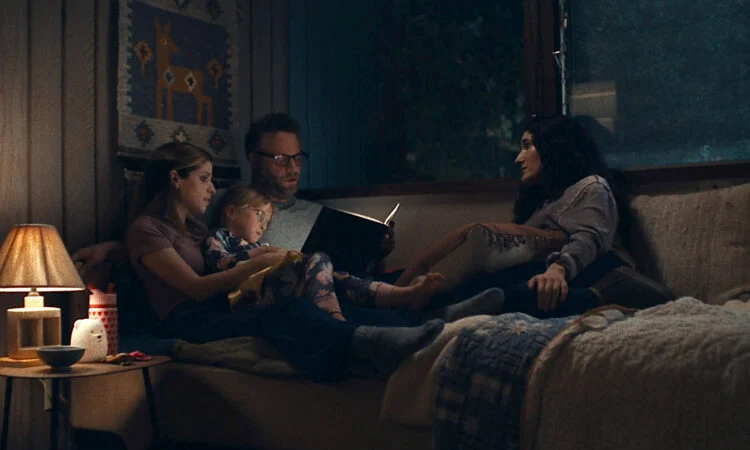
When you’re happily married for two decades and still have no children, the questions are unavoidable. From your loved ones. From strangers. Comments like “Oh, you’d be such good parents.” Or the fake absolutes that your life will somehow be incomplete if you never take that step. Lauren Miller Rogen endured it all without having a definitive answer because she honestly wasn’t certain what she wanted. So, when a friend going through a divorce brought her young daughter to stay with them, she hoped it would help her find clarity.
It didn’t. Not yet at least. Rogen admitted as much during the post-screening Q&A for her sophomore feature Babies by saying she tried to get the experience made into a television series shortly after it occurred. She blames her inability to get it off the ground on still not possessing that answer. Still not having an ending to the story. It wasn’t until she finally discovered it that she could give the fictional stand-ins for herself and husband Seth Rogen a definitive target for everything else to work towards.
There’s a fun synergy to casting these characters as Anna Kendrick (Annie) and Rogen himself (Aaron) since the two worked together the last time the latter turned an experience from his life into a film: 50/50. With them as leads alongside a funny, honest, and sometimes heartbreaking script, it’s no surprise the rest followed. Kate Berlant as recent divorcee Eliza opposite Dan Stevens as Luke, the father of her child. Issa Rae and Zach Cherry as another close friend couple about to have their third child. And David Strathairn as Annie’s dad.
Rogen said it best when mentioning Ron Howard’s Parenthood as a big influence for the structure she sought insofar as presenting the myriad ways in which love and parenting manifest. No two couples are the same. No situation is objectively better or worse than the next. It’s all about the players, their respective reactions, and the decisions made as a result. A child didn’t split Eliza and Luke apart, but you cannot definitively say it wasn’t a factor. That’s the thing about risk. You don’t know what you don’t know. It’s all an educated guess.
This truth is the core message of the film. Here are all these scenarios from the joy of going to an arcade and having a blast with kids to the frantic horror of taking your eye off a child and having zero clue where they went. Here are all the parents making you feel “less than” because you haven’t had kids suddenly telling you it’s so difficult as if the willful hypocrisy has simply flown above their heads. Here’s the information they all received and ignored that you can now weigh together to decide whether you’re willing to ignore it too.
And here’s Anna Kendrick lobbing sarcastic barbs and calling everyone out while taking things a step further to mock them more via voiceover narration. I can’t think of a better steward through the swamp of a very touchy subject than a character with the pragmatism to actually approach this life-altering decision with the attention it demands. Sure, her character might get a little drunk and go too far in one scene, but it doesn’t render her points any less valid. Annie’s not telling them they should’ve worn a condom, so why are they telling her to stop?
I mean, she does say it. Or at least condones it when Aaron does. It’s part of why their marriage is so strong. They are on the same wavelength. They can see through the chaotic pretzels their friends have twisted themselves into only to lament the fact “they didn’t know.” It doesn’t mean Annie and Aaron don’t like kids or aren’t good with them. They merely see the risk-reward dynamic in the opposite direction. Why risk what’s already a fantastic life? Parents joke about losing their freedom to mask the fact that it’s true.
As someone in a committed childless relationship that’s approaching two decades, I must admit that it was nice to see a version of us on-screen that wasn’t automatically dismissed as a third wheel. By centering the story on them, audiences get to see that avoiding parenthood doesn’t make them less fun or caring. If anything, it allows them to be the support their parent friends need since everyone else is busy dealing with their own families. They can house Eliza. They can help Annie’s father. They can smoke a joint in peace.
Just because I’m using “they” a lot doesn’t mean Babies isn’t also presenting the additional hardships foisted upon women in these relationships. Aaron is considerate in saying he doesn’t care and will follow Annie’s lead because it’s her body, but that’s still him placing all the responsibility at her feet. It’s the same with Berlant not having the luxury to be selfish like Stevens or Rae needing to prioritize family above the dream gallery she and Annie are trying to build. Motherhood proves a different beast from parenthood altogether.
Add Ed Helms and Sharon Stone in cameos as pretty deplorable human beings (I really thought we were getting a reveal where Annie discovers the former’s character drives the road rage vehicle) and the contrasts between what is and what could be (in both directions) fill the screen from start to finish. Annie absorbs it all. She listens to her body when it gives the green light and listens again when that hue turns red. She experiences love in all its messed up, tragic, and beautiful forms to realize she might already have everything she needs.
Babies premiered at TIFF 2026 and will be released by Roadside Attractions and Vertical.