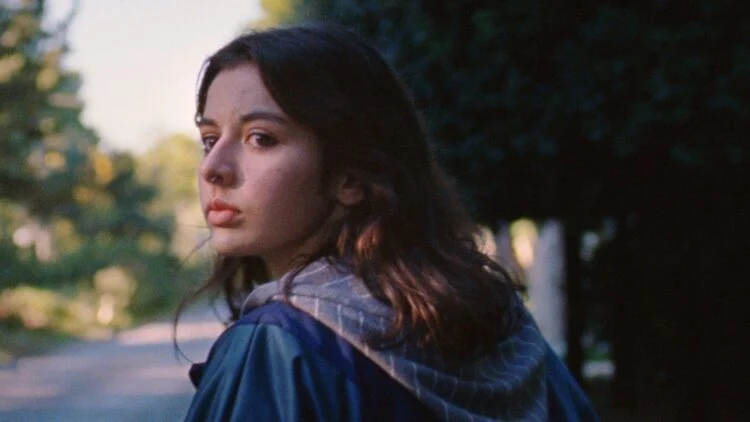

Coming-of-age dramas are so rife with tropes and conventions that coming across one able to subvert them is nothing short of miraculous. Jacqueline Lentzou’s A Day in the Life of Jo: Chapter Phaedra is one such film. In its simplest terms, the story—about a wayward 15-year-old whose world is upended the fateful morning she hears a classmate sing—might suggest another formulaic entry into the canon. But watching that rapport develop, and Jo’s day reach its devastating climax, makes for an electrifying experience. Gradually, Lentzou’s second feature sheds its genre trappings to become something more daring and idiosyncratic. By the time it wraps, Phaedra has ascended to a place that defies facile descriptions, and a chronicle of a few hours in a teenager’s life has swollen into a much stranger, shapeshifting portrait. Straddling the real and supernatural, Lentzou’s film wants to probe the divide between life and death, and cinema’s capacity to bridge the gulf separating them.
It all begins, fittingly, with a dream. We first meet the titular Jo (Evita Andriopoulou) as she naps on a lawn, grass blades tickling her arms and sunlight bathing her face gold. But Phaedra does more than simply capture her sleep. Suddenly, Lentzou beckons us inside her head, and for a few disquieting moments, her dream is ours to behold. Summoned by invisible entities whose voices cannot be heard but read via subtitles, curious items appear from the dark recesses of Jo’s subconscious: a shell, a winged hat, a bullet. It’s the first of several surreal sequences that litter the film; even as Jo awakens, Phaedra remains possessed by a kind of somnambulist trance.
Lentzou has a yen for off-kilter images, and what’s so astonishing about her film is how it can seamlessly convert its unassuming settings into a wellspring of wonders. Strip-mining drab locales for magic is a skill her cinematographer, Grimm Vandekerckhove, has long finessed, most vividly in his collaborations with Bas Devos. Their second, Here (2023), made Brussels’s outskirts and the forests surrounding them teem with wondrous visions. So does Phaedra. Jo’s turf is an anonymous stretch of suburbia dotted with manicured gardens and station wagons, her high school so nondescript that were it not for the language caroming off its walls you could imagine the building sitting anywhere in continental Europe. But Vandekerckhove demonstrates an effortless ability to complicate these mundane backdrops. Throughout, he uses mirrors and reflecting surfaces to dizzying effects. Faces come out distorted, objects become optical illusions—early on, the camera gazes at the reflection of troffer on a window, leaving the light fixture to seemingly float against a cloudless sky, a singular apparition in a film that’s full of them.
Conversations around emerging Greek filmmakers courting the surreal almost inevitably land on the same stultifying questions around their proximity to the Greek New Wave—as though anything remotely bizarre to come out of the country should be automatically written off as an offshoot of that movement. And sure enough, Phaedra is weird. But the oddness Lentzou evokes is markedly different from the kind that animates works by Yorgos Lanthimos or Athina Rachel Tsangari. Phaedra carries none of the Wave’s cynicism. Unsettling as it unfailingly is, Lentzou’s sophomore communicates a contagious affection for its protagonist: the film’s strangeness is inseparable from all the empathy it radiates.
That’s likely a function of the true-life tragedy that inspired it: the murder of Alexandros Grigoropoulos, a teenager who, in 2008, was shot dead by cops in Athens. While the senseless assassination triggered riots all over Greece, Lentzou isn’t interested in rekindling old polemics. It isn’t anger that powers Phaedra, but an unarticulated longing that’s conjured long before a momentous twist. You can sense it in the silence that seizes the corridors of Jo’s school, in the amber glow of Vandekerckhove’s palette, and in Andriopoulou’s face as it alights upon hearing the Phaedra (Anastasia Gouliamou) steal the show during music class. It is a key juncture—the film’s first: accompanied by their teacher at the piano, students take turns to sing before their peers, and no sooner does bookish Phaedra start crooning an old ballad, “The Rose Tattoo,” that tears begin to lap Jo’s cheeks. Phaedra’s angelical voice hits her with the unbridled force of a revelation, but Lentzou’s script doesn’t spell it out in full. The two girls meet again at recess and sort of tiptoe around each other, timidly sharing music recommendations before deciding to go to the movies in the evening.
That, in a nutshell, is all there is to Phaedra’s plot, yet Lentzou isn’t beholden to prosaic concerns around narrative or chronology. Her film doesn’t work through scenes but shards of them, obfuscating your sense of time to such degree that it can be difficult to tell when the action, such as it is, takes place. And there’s something entrancing about the way Vandekerckhove’s camera gets distracted, sidelining people to single out odd things happening all around them—the way the light dances on walls and furniture, or the serendipitous rendezvous intersecting Jo’s routine. No point spoiling the third act’s foray into the otherworldly. Suffice to say that, visually bold as this segment is, it is only the natural culmination of a journey designed to familiarize your senses to the mysteries lurking everywhere around you. It is a measure of Lentzou’s artistry that her film, in its own discombobulating way, teaches you how to see them.
A Day in the Life of Jo: Chapter Phaedra premiered at the 2026 Venice Film Festival and screens at the 64th New York Film Festival.