“My own destruction might be exactly what I want.” – Leo
Italian cinema maestro Bernardo Bertolucci died in 2018, leaving behind one unfinished screenplay. For his fourth feature, burgeoning Italian writer-director Andrea Pallaoro was given the keys to that coveted, unfinished script. Pallaoro finished writing the screenplay alongside Bertolucci’s original co-writers, Ilaria Bernardini and Ludovica Rampoldi, before he took the reins. The Echo Chamber doesn’t feel or play like a Bertolucci film. His spectre is there in the dialogue, the scenario, and the realist restraint. But Pallaoro brings his distinct style to the homebody story, one traced through long, still, quiet shots that hold the unspoken tension of the frame and the messy conflicts within.
In a ritzy flat in London, the film opens with a bang: renowned record producer Leo (Luca Marinelli) lines up crisp streaks of white powder to snort while he bounces around to blasting club music, the likes of which he doesn’t produce. Anne (Alicia Vikander) walks through the door, surprised to see Leo in such a state but swept into a second-hand high by his tender, narcotized romantic passion almost immediately. We don’t experience that high level of energy for the rest of the film.
It’s the only glimpse of inebriated euphoria—and loudness—we get from Leo’s addict phase, and it’s an affecting move for Pallaoro to start there out of context. He shows us something seemingly innocuous, then slowly unpacks the grueling affliction and pain associated with it, both for Leo and Anne. The scene ends quickly with Leo overdosing in Anne’s lap, and the severe stakes of the soft, bitter, pensive drama set in.
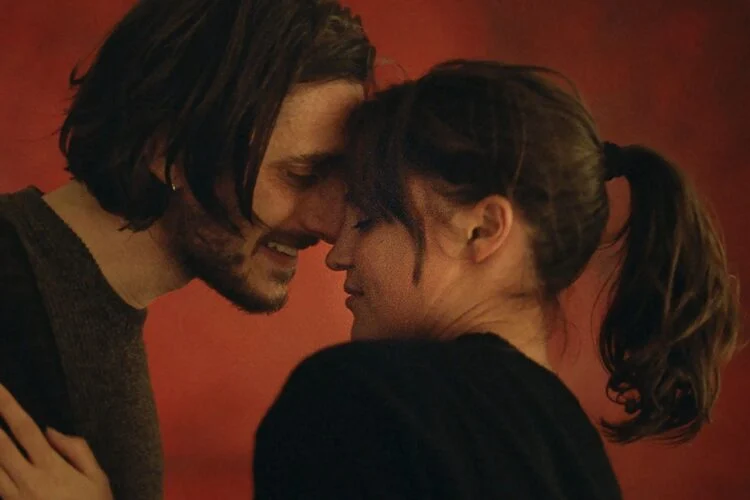
Anne, a physiotherapist, meets Leo, a victim of chronic back pain, when she starts making clinical calls to his flat, acting as both masseuse and doctor. It doesn’t take long for the lovebirds to fall head-over-heels for each other, and it takes even less time for that love to become codependent obsession, a floating metaphor for the substance abuse to come. The muscle therapy and massages only do so much, so Anne prescribes Leo opioids for the pain. One life-threatening addiction later, she’s drowning in the guilt of having introduced him to his potential end.
All of this happens in the process of Leo recording an album with the sultry (fictional) great Ava May (Susan Sarandon, who Pallaoro is smart to bring back into the songstress spotlight, where she blossomed with The Rocky Horror Picture Show in 1975), who occupies a dark, hushed, smoky singer-songwriter territory. But he has to put the record on hold to go to rehab, during which Leo and Anne never see each other. However, they’re constantly walking in the other’s wake. Anne lurks around his apartment while he’s at rehab—to smell him, to touch the things he touched, to feel some kind of phantom connection. Eventually, Leo realizes she’s doing it.
In each other’s absence, they leave easter eggs of care and affection that could be final sentiments or bridges to reconnection, like the smell of her hair on his pillow or a broken coffee mug miraculously glued back together. The story plays out in a non-linear fashion that constantly jumps around the timeline, which Pallaoro uses to his advantage to mix viewers up and keep the plot intriguing. For example, it takes a while before we realize Anne turned him onto the juice. Just like it takes a while in most sequences to understand whether we’re in the past or present.
Intentionally stunted by the thematic brutalization of addiction, The Echo Chamber rarely leaves its room, hence the title. Leo’s dark-colored apartment is designed to be an echo chamber of sound, light, color, and habit. It’s his place of recovery, where he loses himself to opioids, where he falls in love, where he works tirelessly, et al. The flat is filled with a burnt shade of blood red that can be found everywhere—Leo’s clothes, the opening and closing credits, and the most tasteful red-outs since The Zone of Interest—and creates the feeling of Leo slowly bleeding out at all times. In contrast, the murky, modern-arty cesspool walls of Leo’s apartment are perfectly thematized, contrasting the deep blood reds with a lifeless, if not toxic, blotchy shade of green that plays like a layer of algae growing all around Leo in his addiction and recovery.
Marinelli and Vikander are terrific together. The aching connection between the two is palpable in their absence from one another, in their suffering silence. Their chemistry is strong, but because of how detached they are most of the time, it’s less about chemistry and more about the individual performances they put forth, where you can feel the ghost of chemistry past in the panged longing they feel for each other. Diego García’s cinematography is also worth writing home over. There’s a litany of incredible reflective shots with immersive depth of field where you genuinely can’t tell what’s foreground, what’s background, what’s in focus, and what isn’t, because there are so many layers to parse through.
Unlike most films of this ilk, Pallaoro’s take is a gentle account of life-threatening addiction, one mostly captured in the muggy lows of astrally brief sobriety—as opposed to the rivetingly false highs of intoxication—and the confusing in-betweens, in which very little about time, place, or personage is known by simply being awake. It’s far from a perfect movie, and it’s not Pallaoro’s best (that title still belongs to Monica), but, to his credit, it’s hard to stop watching once you’re invested. Whether or not viewers will stick around through the dark tone, quiet atmosphere, mournful mood, swampy look, and slow-burn edit to become invested is the question.
The Echo Chamber premiered at the 2026 Venice Film Festival.