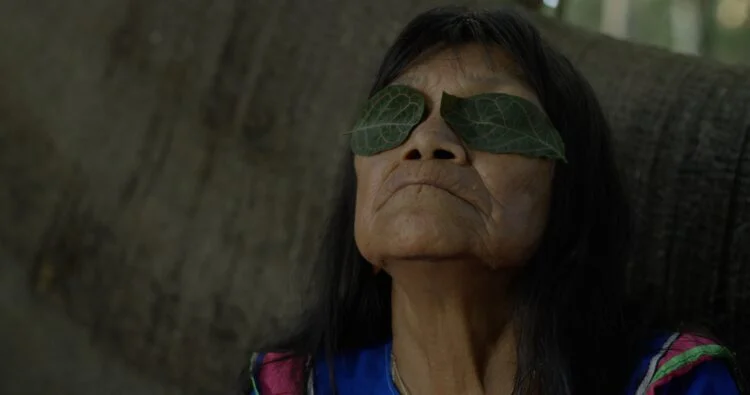
Seventy-five year-old Indigenous Peruvian artist Sara Flores came to fame late in life, as she acknowledges in The Hummingbird Paints Fragrant Songs. Yet her art and activism resonate with force and conviction in this elegiac portrait by Èlia Gasull Balada and Matteo Norzi. A woman of the earth, Flores forages for resources in the forests surrounding her home and creates her traditional Kené art, with its entrancing bursts of color amid interlocking geometric patterns. But her artistry and way of life are under threat from settlers seeking to denude the Amazon of its natural resources for capitalistic gains. Norzi and Balada gently chart the origins and meanings of Flores’ ancestral creations and the ecological calamities that threaten them.
We first encounter Flores amid sylvan, virginal landscapes, wise to the abundance around her, living a modest life in harmony with nature and the land of her forefathers. She wears beautiful traditional clothing that represents her culture and heritage. It is thus a jarring jump scare to see her in business class on an airplane or with a Starbucks cup in Central Park, or driving by the Arc de Triomphe in Paris. This is precisely the juxtaposition the filmmakers revel in, as they locate the artist not just in her habitat but in a cosmopolitan world that has discovered her art and wants to fete her.
We see enlightened, educated patrons crowd about her works in art galleries in New York, Paris and Lima. She observes with wry amusement that they seem like parrots, nodding their heads and chattering incessantly. Western contemplation of her art is always respectful, but there is a whiff of gainful exploitation. Her designs are repurposed, with her approval and participation, for designer Dior handbags that will be sold for thousands of dollars. We can only hope that some of the royalties will find their way back to Flores and her Shipibo-Conibo community.
The directors, and Flores for that matter, do not shirk from the commercial considerations of making art. Flores notes that even at her advanced age, she is the breadwinning matriarch and has to provide for children and grandchildren, and her art is her only calling. It is poignant to have her contemplate encroaching health issues that are unavoidable at this time in life: her mind isn’t as sharp as it used to be, she confesses, and her fingers and hands ache with numbness. This is due to the entirely manual, artisanal quality of her work. She draws and paints freehand, without rulers or compasses, and yet achieves entrancing, kaleidoscopic beauty.
The camera observes Flores with admiration and equanimity. The directors have fun filming her diminutive figure dwarfed by modern structures in the cities she visits. A montage of her works poignantly morphs into her MRI scans, which show concerning developments in her brain. Flores openly grapples with mortality, remarking that she still has designs she wants to pursue. It is doubly upsetting to realize that the settlers threatening her surroundings might stop her before her body does.
Blending the quotidian with the remarkable, in an amusing scene, Flores wonders if wearing heels to a fashion event will give her a cramp. And her playtime with her pet monkey is consistently adorable. The humor exists alongside moments of grace. At an exhibition, Westerners line up to receive the traditional Indigenous blessing from her as she rubs ointments on their faces and arms. It is her tactile art communicated through touch, and the ennobling quality of human creation.
The need for human artistic expression is fundamental, going back millennia. Art is elevating and dignifying and not the sole domain of the urban, the privileged or the wealthy. It is a repudiation of the manner in which people observe Indigenous communities: at one point, Flores’ daughter remarks that people in cities look them up and down as if they belong in the forest.
Like the greatest artists, Flores isn’t content to rest on the laurels of Western adulation. This is a film that shows her using her clout for good, advocating for the sovereignty of Indigenous rights, the need for ecological safeguards, and the reversal of materialistic encroachment. A soundtrack of shamanic chants and songs completes our immersion in Flores’ world, while the film engages frankly with her spiritual traditions and beliefs. In Balada and Norzi’s hands, The Hummingbird Paints Fragrant Songs becomes a humanistic portrait of an Indigenous Peruvian woman as artist, activist, and cultural custodian.
The Hummingbird Paints Fragrant Songs premiered at TIFF 2026.