“I need to be myself / I can’t be no one else.” Has an opening line of a first release better captured the appeal, complexity, and intent of a band than Oasis’ 1994 debut single “Supersonic”? This sense—that brothers Noel and Liam Gallagher could never, ever be anything but themselves—is why the idea of an Oasis reunion following the Manchester legends’ volatile 2009 split seemed so far-fetched. Sometimes, however, guns fall silent, stars align, attitudes evolve, and a great wait is over. Audiences have a front-row seat for such a weighty occurrence in the extraordinary documentary Oasis: Don’t Look Back in Anger, which serves as the concluding chapter of a quasi-trilogy that began with 2016’s Oasis: Supersonic and continued with 2021’s Knebworth 1996.
Directed by Meet Me in the Bathroom documentarians Will Lovelace and Dylan Southern and written by Peaky Blinders creator Steven Knight, Don’t Look Back in Anger offers something quite unique in the music documentary genre: a literal backstage / rehearsal-room glimpse of a musical reunion. We’ve witnessed endings in films such as The Last Waltz and Let It Be. To see a band reunite—two brothers, no less—is a far different experience. There have certainly been other shocking musical reunions; the Eagles called their mid-90s tour “Hell Freezes Over” for a reason, while individuals as combative as the members of Guns N’ Roses, Simon and Garfunkel, and Fleetwood Mac have managed to reconnect for hefty paydays. Sometimes these reformations sputter out (see: Jane’s Addiction). And occasionally the result is literally a one-time deal, like Pink Floyd at Live 8 or Led Zeppelin’s 2007 London performance.
The 2025 Oasis reformation was something different. No new music was in the cards, and neither Gallagher gave a sobbing, world-exclusive interview. This series of concerts was about the fans, the feeling, and the music; as a fully sober Liam states, “Them songs need to be treated with the utmost respect.”
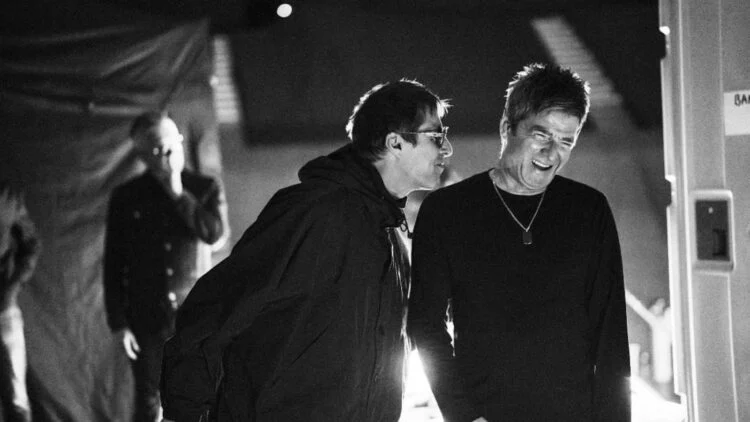
Oasis: Don’t Look Back in Anger makes clear in its opening moments that part of the appeal of the Gallaghers was the knowledge that implosion was ever-imminent. The first few minutes have remarkable energy, archival clips soundtracked by what sounds like thousands of feet stomping in unison. All roads lead to Paris in 2009, the site of a row that culminated in a 15-year split. While we all know that the band did finally reunite for a successful, well-behaved (by Oasis standards) world tour, Don’t Look Back in Anger offers what we haven’t seen: the actual moment Liam and Noel spoke for the first time in 15 years. It occurs during tour rehearsals, which Liam didn’t join right away. (Now that’s drama.) The pounding of a drum tech as the rehearsal room awaits Liam’s arrival underscores the tension, and directors Lovelace and Southern brilliantly cut between the band in 2025 and old footage. The camera was hiding during much of this shooting, and the results are wonderfully unguarded.
Soon the tour begins, and throughout this globe-trotting footage the film shares sweet fan stories. (My favorite involves a dog named after Oasis guitarist Paul “Bonehead” Arthurs.) One overarching theme, hammered home via onscreen comments from fans, is the connection between band and audience. “The gigs were great because we made them great—us and the crowd,” Noel says, clearly moved. Never have we seen and heard more emotion from the generally stoic elder Gallagher, whose father was infamously abusive (this somber element of the brothers’ story is detailed in Supersonic). It’s meaningful (and a bit sad) to hear him note that the sight of so many fathers and sons in the crowd chokes him up, and no wonder Lovelace and Southern show so many younger people in the crowd. One of Don’t Look Back in Anger‘s most memorable moments is among its most subtle: the camera finds an emotionally overcome teenager, post-gig, who has been crying on the floor, like many attendees, and slowly pulls on his jacket before someone (who may be a friend, father, or random concertgoer) gives him a warm hug.
When Oasis was in its first incarnation, a friend and I would often discuss the possibility of the eventual Oasis movie—in our lager-fueled minds this would be a biopic, not a documentary. We agreed without hesitation that the proper director for such an undertaking was clearly Oliver Stone (this was the late-90s). He could capture the paranoia, the tension, the simmering anger, the debauchery, and the excess as well (if not better) than anyone, we felt. (A more cultured younger version of me may have pushed for Mike Leigh.) That was then. But as Noel Gallagher states more than once in Oasis: Don’t Look Back in Anger, the 2025 reunion changed the narrative of the band. Once, he explains, the story was “fucking great, chaos.” Now, it is “fucking great, chaos, and fucking great when they came back.” Perhaps these words lack the simple eloquence of The Straight Story, but they’re emotions with which anyone can identify, fan or not. Steven Knight, Will Lovelace, and Dylan Southern clearly understand this, and that makes them the proper trio for this particular Oasis tale.
But the real significance of the reunion, and this project, is far more than simply “fucking great when they came back.” The audience, a Manchester priest states, “came for the reconciliation of Noel and Liam.” That reconciliation matters. Don’t Look Back in Anger spends a significant amount of time on the death of Gary “Mani” Mounfield, bassist for the Stone Roses and longtime friend of the band. His death in 2025 came as a shock, and for the Gallagher brothers—then in the midst of their tour—seems to have served as a jarring reminder that no one lives forever. Even more sobering is a sequence focused on the 2017 Manchester Arena bombing. The Noel-sung “Don’t Look Back in Anger,” which famously became a Manchester rallying cry, has never felt more forceful than during this clip from Wembley Stadium.
It is fitting that Burt Bacharach’s “What the World Needs Now Is Love” plays late in the film; Noel is a self-professed Bacharach stan and the lyrics are beautifully direct. Yes, “what the world needs now is love” is a trite sentiment. But as Oasis: Don’t Look Back in Anger shows, sometimes it’s true. One of the most surprising moments occurs when Camille Saint-Saëns’ lovely “Aquarium” from Carnival of the Animals plays over footage of the horrors (mostly political) of the last 15 years. “When Oasis split up things went to shit,” Noel states with his usual candor. “People more than ever now, they want to escape.” The concept of breaking free from one’s day-to-day reality is a constant theme in the band’s work. Of course, for better or worse, there is no real escape from family. Noel marvels that his children and Liam’s had never met prior to the 2025 tour, and now are best friends. Perhaps, this film implies, all the bullshit (30 years’ worth, Liam reminds us) was worth it for the next generation to come together. The most profound takeaway from Oasis: Don’t Look Back in Anger is the realization that the catharsis of an artist can be felt just as deeply by those outside the band—even the audience.
Oasis: Don’t Look Back in Anger is now in theaters.