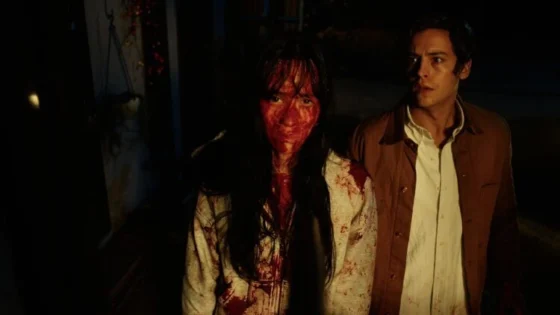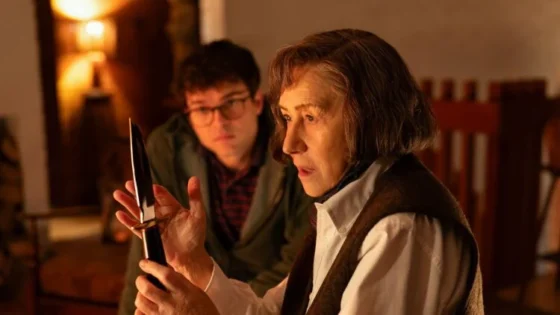
On a stormy night in Rome, Anna Colonna (Jasmine Trinca) shows up unexpectedly at the apartment of her daughter Alice (Romana Maggiora Vergano). With a look of distress, Anna explains that the purpose of her sudden arrival requires her to start from the beginning to explain an awful, rotten confession: since the turn of the century, their family history has been based on a lie. So begins The Spiral, Paolo Strippoli’s devilishly fun Twilight Zone-esque tale told over four chapters and an epilogue. Think Richard Matheson’s short story The Box scaled to apocalyptic heights, where a mother’s guilt traps her unaware family into a decades-long barter system from hell. It’s stylish and silly, with two excellent performances that play against each other perfectly to deliver an entertaining romp.
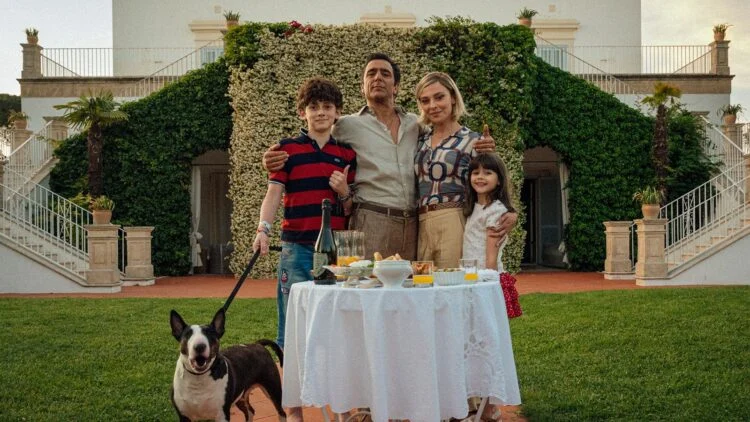
The first chapter takes us back to 1999, where the Colonnas have a seemingly perfect life after acquiring a lavish estate in Bari. Father Walter (Adriano Giannini) makes plenty of money at his job, their 13-year-old son Tobia (Alessandro Carbonara) has a girlfriend and goals of becoming a pro soccer player, and Anna screams with delight at the news that then-seven-year-old Alice (Gabriella Telegrafo) just booked a role in a Barilla pasta ad. Strippoli and cinematographer Cristiano Di Nicola lay the lavish camerawork on thick in this early section, with plenty of grandiose pans and tracking shots that highlight their lush lives, until tragedy strikes when their new dog mauls Alice.
With the likelihood that Alice will lose one of her legs, a desperate Anna runs to the hospital chapel, only to find herself approached by a mysterious woman (Valeria Bruni Tedeschi, credited as The Stranger). Dressed in a trenchcoat and rocking a slick bob, she claims to be able to save Alice’s leg but at the expense of Tobia’s health and appearance. Anna agrees to the trade, and while Alice does miraculously recover, over the following years we see how Tobia’s condition puts a significant strain on him and his family.
While this is the weakest section of The Spiral for its questionable choices in portraying Tobia––let’s just say the attempt to bypass its problematic depiction by tying such to the family’s vanity is a case of having its cake and eating it too––it’s Trinca’s grounded performance that stops the film from veering off into cheap exploitation. Racked with guilt and constantly convincing herself she did the right thing, Trinca brings a surprising amount of nuance to a role that upholds her as a sympathetic figure even as she makes one worse decision after another. Meanwhile, Tedeschi brings an unhinged energy to her role that makes the film crackle every time she struts back on screen to offer Anna another Faustian bargain. Ranging from caring to cruel to horny from one line to the next, Tedeschi’s playful malevolence breeds one of her best performances to date.
Admittedly, the direction and writing (with Strippoli and Salvatore de Chirico as co-scribes) can get a bit too ludicrous to fully embrace The Spiral, which relies on poor jump scares and corny, stylistic flourishes from time to time. But with each twist and turn, Strippoli makes clear he just wants to have a fun time. There’s a perverse delight in watching the walls close in on Anna as she seals the fates of her loved ones, and The Spiral is more than happy to let you feel good about it. It’s a trade-off worth taking.
The Spiral premiered at the 2026 Toronto International Film Festival.