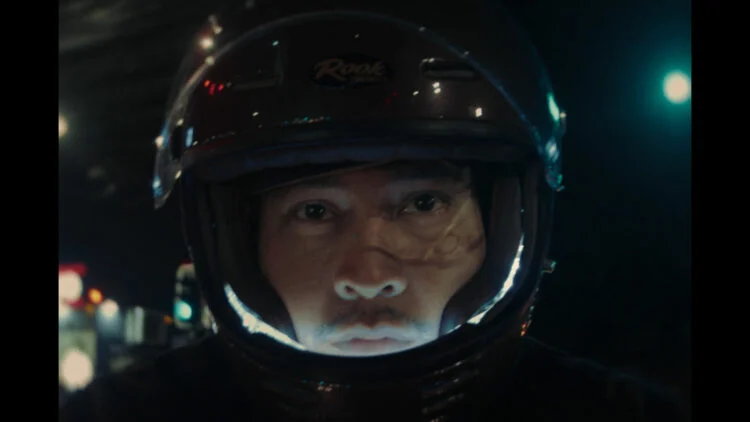
Would you give yourself over to an app? Become a passenger in your own life, unable to steer from danger when it’s coming full speed? The obvious answer would, of course, be “no.” Yet so many do exactly that. Not necessarily with an app (although we’re definitely on the path towards that option) but drugs, sex, sports, etc. We crave the distraction when our reality is too much to bear. We don’t want to crash, but we welcome its opportunity to feel.
So you can’t blame the victims Detective Mijares (Alchris Galura) finds littering the streets of his town outside Manila. You can’t judge them for wanting to disconnect from the external noise of bosses, parents, and spouses, as well as the internal sound of their own self-loathing and depression. This is especially true when you consider the voice the app takes is said to be one that reminds you of home. Safety. Love. The voice of someone long since gone.
Who would that be for Mijares? His late wife, Maria, who passed one year ago. He yearns for a sound he’s found himself forgetting at the same time as being unable to escape her memory. She’s become a ghost within his life—figuratively (her brother asking his phone if he should still call Mijares “in-law” despite her death) and literally (his niece not letting him sit in a certain chair because it was saved for Auntie Marie).
It’s part of why he’s looking to leave town. He wants to put the past behind him and start anew… or maybe his destination is actually one that will help him reclaim what’s just out of reach. To that end, it’s not wrong to wonder whether Marie is dead at all. Not when Mijares has difficulty remembering what happened. Natural causes? Something unexplained? His voiceover is never quite sure. Nothing about John Torres’ The Remotes is.
The film, co-written by Dodo Dayao, is the director’s own bid to reach out and talk to a loved one who’s no longer on this earth. The final line in the credits states as much: “For my mother, Alice, who asked for a real film.” Torres’ says the work is a dialogue with her and a gift after years of her politely, proudly being confused while watching his output. It’s a manifestation of grief and love. A work guided by emotional purpose.
It’s no wonder that the film I most thought of was David Lynch’s Lost Highway. Between The Remotes‘ darkly surreal noir mystery and the unnaturally cyclical nature of its visuals and sound, you wouldn’t need to twist my arm to make me believe everything onscreen is a dream. It’s not—Mijares isn’t the only one desperate for solace—but that doesn’t mean most is. Call it coincidence, fate, or delusion; nothing should be taken at face value.
Does that mean the motorcycle-driving Donnie (Enchong Dee) is a surreal substitute for Mijares upon his arrival in the second of four vignettes? No. But I definitely thought it for a second. Just like I thought the sisters Mijares is investigating (Gabby Padilla’s Gill and Julia Richards’ Eva) were the creators of the mysterious app everyone is gravitating towards. Or that the improved driving seminar they run uses simulators to unwittingly control strangers.
This isn’t quite the case, though. They are victims to its allure as well—two women dealing with the loss of their mother. It creates an interesting vocal dynamic: Gill thinks Julia sounds like their mom and her voice might have been co-opted by the app (unless they both simply think it’s her, like so many others believe it to be their own “person”). You must pay attention to the sound mix to discern when voices are real, recorded, or potentially imagined.
It’s not an easy task beyond the couple instances where someone tries to turn off their AirPods only to blast the voice through an external speaker for all to hear. This is intentional. Just like the intuitively fluid editing that suggests you’re moving through time and space. Add the repeated phrases (“If you’re looking for clues, it’s my blouse”) and visual motifs and you become desperate to fit puzzle pieces that might be mixed from fifteen different boxes.
Instead we must attempt to decipher the emotions. Dig deeper than the surface—an often beautiful one, with unforgettable moments like a long take between Galura and Padilla in a mirror-filled apartment kitchen—and recognize that what we see is less important than what we hear. Case in point: the characters randomly singing their lines as Mijares’ narration reminds us “everyone singing is Marie.” Is it actually happening? Or is he reaching back into his mind?
The Remotes is, in many ways, a cinematic representation of déjà vu; we are always trying to figure out if that thing we experienced is happening again or asking us to remember when it did. There’s all the times Donnie crashes (one scene might even show Eva dragging two different Donnies into her house at the same time). The adventure taken by that blouse courtesy of the second-hand store to which Mijares sells it. A movingly chilling climactic conversation with Marie.
At a certain point I began to wonder if Torres has neither created a dream nor a reality. He’s instead giving shape to the fact that we stop being the people we were when tragedy strikes. Something dies within us, either from an absence or inability to leave loss behind—a phantom limb. We are always in dialogue with dead people, places, ideals. Always reminiscing and torturing ourselves. Always trying to fix what isn’t broken instead of confronting the change.
As seen onscreen, some face that challenge better than others. Some journey to where they wish they could have gone but didn’t. Some find a way to live in the moment between having just lost it and excitedly waiting to find it again. Some fall into oblivion. Thus it’s less about wanting that voice or receiving it than what you do with it. You mustn’t crash merely because it guides you into a wall. You can endure the pain by pulling away.
Or maybe that’s my own hopeful optimism. Maybe you’ll see it a completely different way. I’d like to believe that’s Torres’ goal. That the film’s dream-like formal qualities are meant to act as scaffolding for the audience to project their own thoughts, feelings, and ghosts upon. Either way: The Remotes is the sort of complex art that begs for a rewatch to catch missed connections you didn’t know to spot. Put down your apps, take a seat, and let go of the wheel.
The Remotes premiered at the 2026 Toronto International Film Festival.