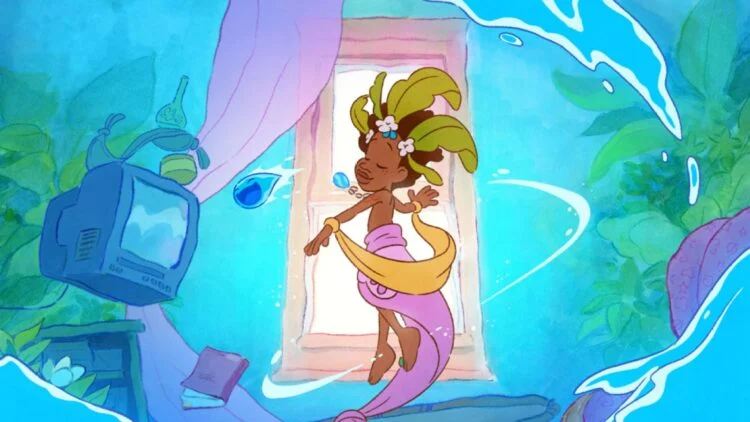
In Jessica Love’s picture book Julián Is a Mermaid, young Julián is introduced while riding the train with his Abuela. Their afternoon adventure leads to her Brooklyn apartment where his love for mermaids takes control to excitedly rip down curtains and pluck houseplant fronds to become one himself. Rather than yell about the mess once reality sets in, Abuela adds the finishing touch to his costume before taking Julián to the Coney Island Mermaid Parade.
A 36-page tale about imagination and acceptance that would work wonders as an animated short, director Louise Bagnall pitched Love the idea of expanding her world into feature-length format. With screenwriter Juliany Taveras and co-directors Guillaume Lorin and Mark Mullery in tow, the result becomes a summer-long experience that sparks Julián’s passion for mermaids and better contextualizes Abuela’s reaction to it.
Much of the rocky road is foreshadowed by an awkward drop-off by Julián’s (Knyght Darius Jack) father Javi (Anthony Sardinha). The boy is jazzed to meet his grandmother for the first time and can’t stop talking about all the ocean-related wonders he hopes to see in Brooklyn. Javi’s reacts nervously: he knows Abuela’s (Milcania Diaz-Rojas) complicated relationship with the water after moving here from the Dominican Republic.
The cultural clash that ensues is perfectly measured for laughs (Julián has zero interest in eating her authentic Dominican dish for dinner) and drama (Abuela tells him they will get along fine if he follows her rules). Julián isn’t like his father, though—something Javi does a bad job explaining due to his own fears about how she’ll react. He’s not interested in baseball cards or being quiet. He wants to bask in the colors and energy that his Afro-Caribbean heritage holds.
Everything is thus filtered through a lens of misunderstanding. Julián’s penchant to create a mess isn’t because he’s a troublemaker. He’s merely a dreamer who’s conjured an imaginary figment of his seemingly infinite supply of joy via a floating water droplet named Luna. And Abuela’s impulse to always respond to his needs and chaos in the wrong way isn’t from some unwillingness to accept him. She’s just operating from a heteronormative baseline.
Bagnall and company have presented this adaptation with a feeling-out process that finds both characters at an identity crossroads. Julián is at the front end of his, not knowing that wanting to befriend a trio of young mermaid lovers (Zariah Georgia Ellis, Emma So, and Avery Star Pryce Tibayan) and join their costumed team for the upcoming Mermaid Parade could be seen as odd. That confidence inevitably leads to strangers teaching him a painful lesson.
Abuela is on the back end. Assimilation to American ways have stripped her of love for water and a joie de vivre. Between the homesickness and this new world’s grayness, her means of protecting her grandson is less about preserving his innocence and personality than adhering to everyone else’s ignorance. Are her choices due to fearing for Julián or fearing what he might bring back to the surface in herself?
We’re witnessing the parallel trajectories of Julián facing the potential of having the light within him snuffed out and Abuela reconciling the fact that she’s already lost it. So their dynamic is often adversarial, the two often coming from a much different place. Not purely from bigotry (although it does crop up in purposeful and implicit ways) but because of life having a way of erecting barriers for us to break down.
Some are external. Most are internal. Few can be defeated without someone in your corner to fight back. That’s where Julián’s new friends come in. It’s where the block’s bodega owner Fran (Manuel Rodriguez-Saenz) can help just by showing enthusiasm for Julián’s ambitions without a shred of judgment. Even Abuela’s dominoes friends (Kim Roberts, Stephanie Herrera, and Yanna McIntosh) get there eventually. They just need a push to come aboard.
Once they do, though, the sky is truly the limit. The colors get brighter and the future becomes happier. All of Julián’s flights of fancy—always dealing with water, always impacting the world around him—can start being real. Luna isn’t a trickster. It’s Julián’s light, his soul. Everything it drenches as it races through Abuela’s home is because Julián gets water everywhere. And when the hate and fear start seeping in, it’s not only Luna who loses their glow.
Cartoon Saloon always delivers on the animation front; Julián is no different. As in The Breadwinner and My Father’s Dragon, Bagnall finds a style unique to the story (and different from Love’s book) rather than following any aesthetic the studio is known for via Tomm Moore’s Irish folklore trilogy. Water plays a huge role in the images, whether literally or figuratively—the bright colors and flowing fabrics transport us into the vibrant cultures on display.
Are its themes coded in conversations about sexuality and gender without directly engaging with them? Maybe, but we are talking about kids. The press notes elide them, too, by talking about the book’s “open-hearted approach allowing the audience the space to interpret the story for themselves.” I’ll let the LGBTQ+ community speak on this, but it is an interesting pattern of deflection. Or perhaps a great way to sneak these topics into the mainstream? I’m unsure which.
Either way: Julián is a wonderful example of how children’s fare can handle complex subject matter without dumbing things down or ignoring the very real feelings of shame and isolation kids everywhere experience. And by giving Julián and Abuela their own evolutionary paths, we can see ourselves in both. Because age neither stops us from wanting to be accepted for who we are nor learning how to better accept those different from us.
Julián premiered at the 2026 Toronto International Film Festival.